
Write It Down: Islam’s Blueprint for Fair Dealings - (Al-Baqarah 2:282 )
Bismillahir Rahmanir Raheem
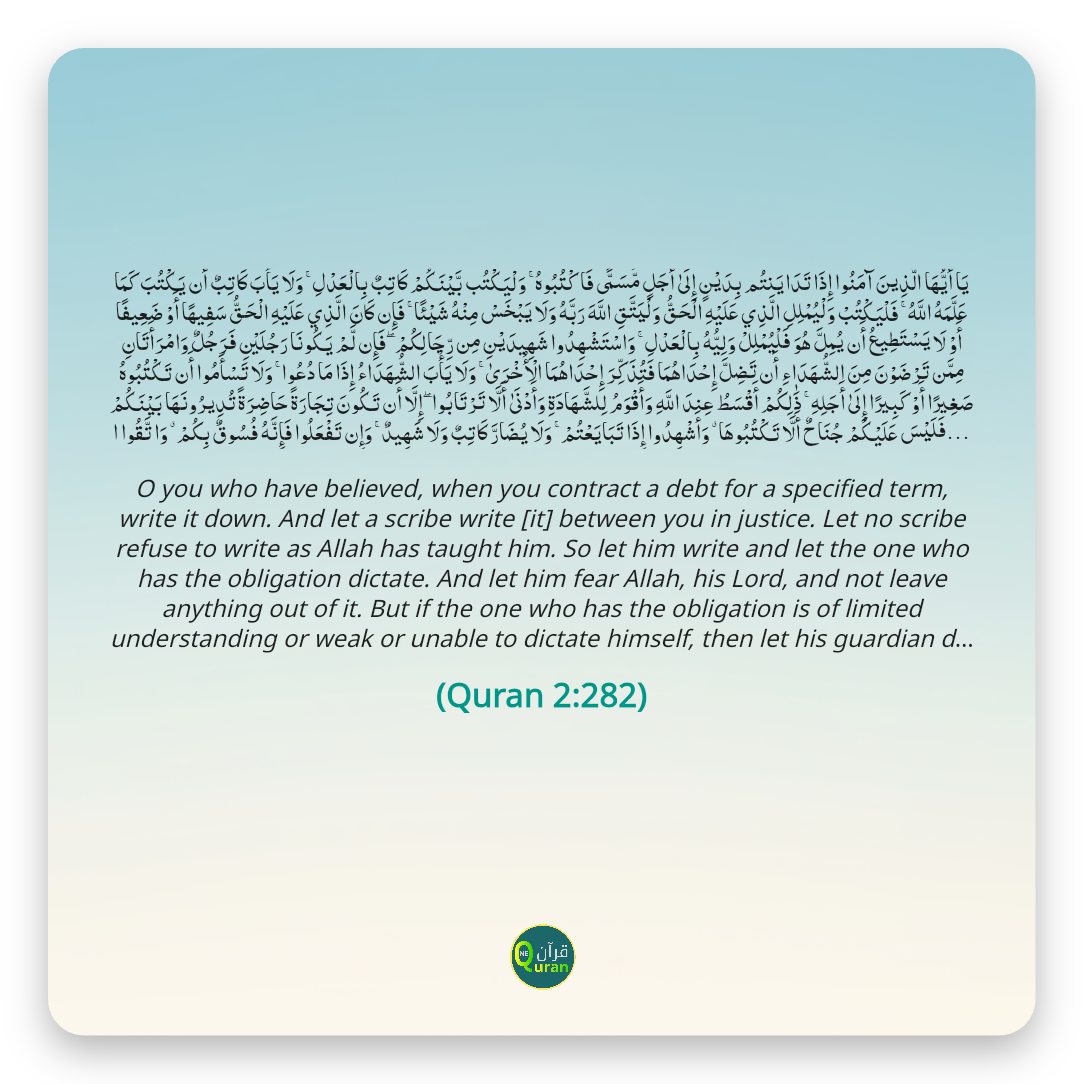
(Al-Baqarah 2:282 – The Longest Verse in the Qur’an)
📖 Context of the Verse
This verse is from Surah Al-Baqarah (2:282), revealed in Madinah, where the Muslim community was developing a structured society — including trade, contracts, and financial dealings.
It is the longest verse in the Qur’an, and it focuses entirely on financial responsibility and documentation of debts.
Islam is not only about prayer and worship — it also teaches economic justice, transparency, and accountability.
🧭 Breakdown & Interpretation
1️⃣ Write Down Debts
“When you contract a debt for a specified term, write it down.”
Islam encourages documentation.
Even between trusted people, write agreements clearly.
✔ Prevents misunderstanding
✔ Protects both parties
✔ Reduces future disputes
This shows Islam promotes organized and professional financial management.
2️⃣ Use a Just Scribe
“Let a scribe write between you in justice.”
The person writing must be:
Fair
Honest
Accurate
This ensures neutrality and transparency.
3️⃣ The Debtor Should Dictate
“Let the one who has the obligation dictate.”
Why?
Because the debtor is responsible for the repayment.
He must:
Speak clearly
Not hide anything
Fear Allah
This reinforces personal accountability.
4️⃣ Witnesses for Protection
“Bring two witnesses…”
Witnesses:
Strengthen evidence
Protect rights
Prevent denial later
If two men are unavailable, one man and two women are mentioned — so if one forgets, the other reminds her.
This reflects the social context of that time, where financial dealings were mainly handled by men.
The key objective here is accuracy and reliability of testimony.
5️⃣ Don’t Be Lazy to Write Small or Large Amounts
“Do not be weary to write it, whether small or large…”
Even small debts should be recorded.
Why?
Because:
Small disputes grow into big conflicts.
Shaytan creates doubt through financial misunderstandings.
Allah says this method is:
More just
Stronger evidence
Removes suspicion
6️⃣ Immediate Transactions
If it is a cash-and-carry trade (immediate exchange), writing is not required.
Islam is practical — it does not overcomplicate daily small purchases.
7️⃣ Do Not Harm the Scribe or Witness
No pressure. No manipulation. No threats.
Anyone who does so commits sin (fusūq).
Justice must be preserved at every level.
🌱 Simplified Understanding
This verse teaches:
✔ Islam encourages written agreements
✔ Protect yourself and others through documentation
✔ Be honest in financial dealings
✔ Fear Allah in business
✔ Transparency prevents conflict
In simple words:
Faith includes financial integrity.
You cannot claim piety while being careless in money matters.
🏢 Modern Application
This verse is the foundation of:
Contracts
Legal documentation
Banking systems
Written agreements
Corporate governance
SubhanAllah — more than 1400 years ago, Allah taught the principles of modern compliance and accountability.
documentation is Sunnah-based governance.
✨ Core Message
“Trust in Allah — but write it down.”
Tawakkul does not mean negligence.
Islam combines spiritual trust + practical structure.
🔑 Reflection Questions
Do I document agreements properly?
Am I transparent in business?
Do I fear Allah in financial dealings?
📌 Conclusion
This verse proves that Islam is a complete system —
not only guiding worship, but also guiding ethical finance and professional conduct.