
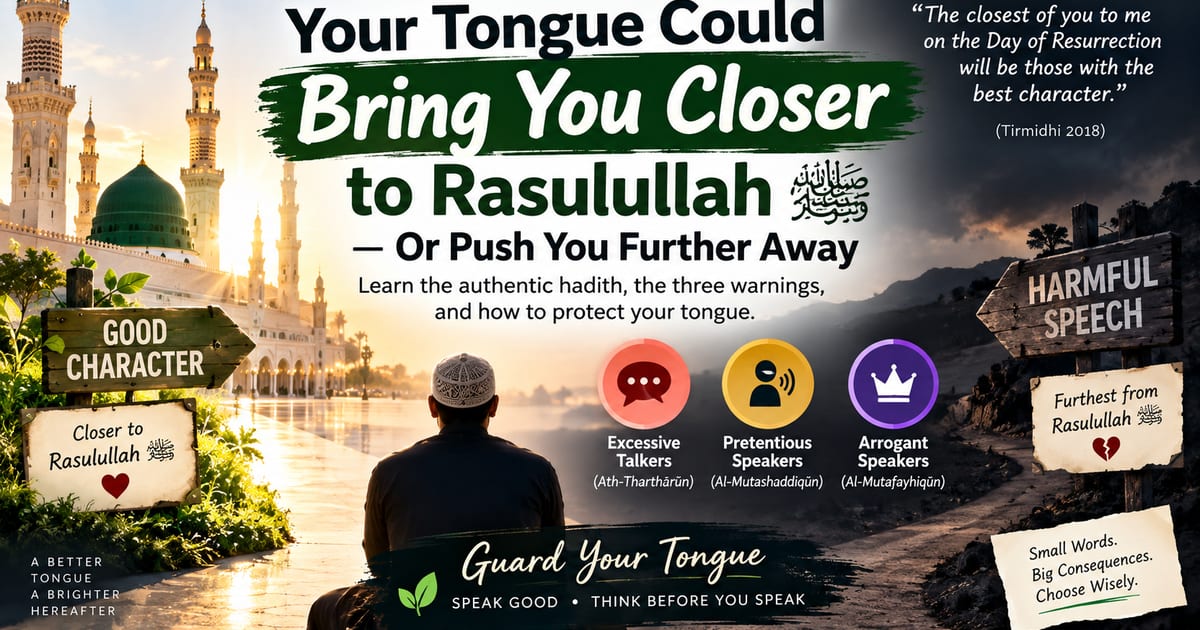
Your Tongue Could Bring You Closer to Rasulullah ﷺ — Or Push You Further Away
One tongue. Two destinations. Which way are our words taking us?
We spend a lot of time thinking about what we do.
How much Qur'an do I read?
How much charity do I give?
How many extra prayers do I perform?
But there is something small that we carry everywhere.
Our tongue.
A sentence takes only seconds to say.
A comment takes seconds to type.
A message takes seconds to forward.
But its consequences may reach all the way to the Day of Qiyamah.
And Rasulullah ﷺ gave us an extraordinary warning about it.
❤️ Who Will Be Closest to Rasulullah ﷺ?
Jābir ibn ʿAbdillāh رضي الله عنه narrated that Rasulullah ﷺ said:
إِنَّ مِنْ أَحَبِّكُمْ إِلَيَّ وَأَقْرَبِكُمْ مِنِّي مَجْلِسًا يَوْمَ الْقِيَامَةِ أَحَاسِنَكُمْ أَخْلَاقًا
“Indeed, among the most beloved of you to me and the closest to me in sitting on the Day of Resurrection are those of you with the best character.”
Then Rasulullah ﷺ gave the opposite warning:
وَإِنَّ أَبْغَضَكُمْ إِلَيَّ وَأَبْعَدَكُمْ مِنِّي مَجْلِسًا يَوْمَ الْقِيَامَةِ الثَّرْثَارُونَ وَالْمُتَشَدِّقُونَ وَالْمُتَفَيْهِقُونَ
Among those most disliked to him and furthest from him on that Day would be:
1️⃣ Ath-Tharthārūn — الثَّرْثَارُونَ
2️⃣ Al-Mutashaddiqūn — الْمُتَشَدِّقُونَ
3️⃣ Al-Mutafayhiqūn — الْمُتَفَيْهِقُونَ
The Companions understood the first two but asked:
“Who are the mutafayhiqūn?”
Rasulullah ﷺ answered:
الْمُتَكَبِّرُونَ
“The arrogant.”
📚 Reference: Jāmiʿ at-Tirmidhī 2018
Authenticity: al-Tirmidhī classified it ḥasan gharīb; it was graded ṣaḥīḥ by Shaykh al-Albānī.
🔎 But What Do Those Three Words Actually Mean?
Let's make them easy to understand.
1️⃣ Ath-Tharthārūn
The Excessive Talkers
These are people who excessively talk and unnecessarily elaborate or affect their speech.
This doesn't mean being friendly, sociable, teaching, giving daʿwah, or simply being someone who naturally talks a lot is automatically wrong.
The warning is against excessive, affected and needless speech.
Today, our “tongue” isn't only our mouth.
It can be our:
📱 WhatsApp messages
💬 comments
📲 forwarded messages
🎙️ voice notes
📹 videos
🗣️ conversations
Before sending something, ask:
“Does this actually need to be said?”
2️⃣ Al-Mutashaddiqūn
The Pretentious Speakers
This refers to people who exaggerate and stretch their speech in an affected way—speaking to impress, show superiority or draw attention to themselves.
Knowledge isn't the problem.
Eloquence isn't the problem.
Speaking beautifully isn't the problem.
Pride through our speech is the problem.
Sometimes we don't enter a conversation to learn.
We enter it to win.
Sometimes we aren't correcting someone to help them.
We are correcting them so everyone knows:
“I know more than you.”
That is where we need to check our hearts.
3️⃣ Al-Mutafayhiqūn
The Arrogant Speakers
For this one, Rasulullah ﷺ himself gave the explanation:
الْمُتَكَبِّرُونَ — “The arrogant.”
They speak with an attitude of superiority—looking down on people and presenting themselves as greater than others.
This reveals something deeper:
The disease may appear on the tongue, but its roots can be inside the heart.
The tongue can expose pride.
It can expose jealousy.
It can expose anger.
It can expose contempt for others.
So controlling our speech isn't merely about keeping our mouths closed.
It is also about cleaning our hearts.
👅 Why Is the Tongue So Serious?
The lecture highlights something powerful:
What do these three categories have in common?
Their speech.
Another reported teaching says that when the son of Adam wakes up, the body's limbs humble themselves before the tongue and essentially warn it:
“Fear Allah regarding us… If you are straight, we will be straight; and if you are crooked, we will be crooked.”
📚 Jāmiʿ at-Tirmidhī 2407 — graded ḥasan by al-Albānī.
Your tongue may be small.
But its impact isn't.
🛟 Rasulullah ﷺ Was Asked: “What Is Salvation?”
ʿUqbah ibn ʿĀmir رضي الله عنه asked:
“O Messenger of Allah, what is salvation?”
Rasulullah ﷺ answered:
أَمْسِكْ عَلَيْكَ لِسَانَكَ، وَلْيَسَعْكَ بَيْتُكَ، وَابْكِ عَلَى خَطِيئَتِكَ
“Control your tongue, let your house be sufficient for you, and weep over your sins.”
📚 Jāmiʿ at-Tirmidhī 2406 — ḥasan according to al-Tirmidhī; graded ṣaḥīḥ by al-Albānī.
Notice where the advice begins:
“Control your tongue.”
💸 The Scariest Bankruptcy Isn't Losing Money
Rasulullah ﷺ once asked his Companions:
“Do you know who the bankrupt person is?”
They understood bankruptcy as someone without money or possessions.
But Rasulullah ﷺ described another kind of bankruptcy.
A person comes on the Day of Qiyamah with:
🕌 Prayer
🌙 Fasting
💰 Zakāh
But that same person had also:
❌ insulted someone
❌ slandered someone
❌ wrongfully consumed someone's wealth
❌ harmed others
His good deeds are then given to the people he wronged.
If his good deeds run out before justice has been completed, some of their sins are placed upon him, and he is ultimately thrown into the Fire.
📚 Ṣaḥīḥ Muslim 2581 — Authentic.
Think about that.
He had good deeds.
The problem was that he didn't protect them.
This is why controlling our tongue isn't a “small sunnah.”
It can be part of protecting the good deeds we worked so hard to earn.
🌊 “It Was Only One Comment…”
ʿĀ'ishah رضي الله عنها once said something concerning Ṣafiyyah رضي الله عنها, referring to her being short.
Rasulullah ﷺ responded with a severe warning:
“You have said a word which, if it were mixed with the water of the sea, would contaminate/change it.”
📚 Sunan Abī Dāwūd 4875; Jāmiʿ at-Tirmidhī 2502 — authentic.
One comment.
One physical characteristic.
One moment.
Yet Rasulullah ﷺ treated it seriously.
Today we might call someone:
“fat.”
“short.”
“ugly.”
“stupid.”
Or mock their accent, colour, family, job, education or appearance.
And then say:
“Relax! I was joking.”
But before Allah, words are not automatically harmless because we called them a joke.
📲 Before You Forward That Message…
The lecture gives this teaching a very modern application.
Someone sends you a “juicy” story.
A screenshot.
A rumour.
A voice note.
A story about somebody's marriage.
A business accusation.
Something about an imam, scholar, friend, colleague or family member.
And immediately:
Forward → Forward → Forward.
Stop.
Ask:
Is it true?
Do I need to spread it?
Could I damage someone's honour?
Could I damage someone's family or livelihood?
Would I say this if that person were standing in front of me?
Not every piece of information that reaches you needs to travel through you.
Sometimes stopping a rumour is itself an act of worship.
🛡️ Don't Just Avoid Gossip — Defend People
There is an even more beautiful level.
Rasulullah ﷺ said:
“Whoever defends his brother's honour, Allah will protect his face from the Fire on the Day of Resurrection.”
📚 Jāmiʿ at-Tirmidhī 1931 — ḥasan according to al-Tirmidhī; graded ṣaḥīḥ by al-Albānī.
So when people begin attacking someone who isn't there, we don't need to become an audience.
We can say:
“Let's not talk about him while he's absent.”
“Do we actually know this is true?”
“Maybe there's another side to the story.”
And if the conversation continues, we can leave it.
That's strength.
🧠 A Simple Rule for Our Generation
Before you:
SPEAK. POST. COMMENT. FORWARD.
Run your words through four questions:
1. Is it TRUE?
2. Is it NECESSARY?
3. Is it BENEFICIAL?
4. Can I say it with GOOD CHARACTER?
If not—
Don't give your tongue permission.
Because sometimes the strongest response is not another response.
It's silence.
❤️ The Bigger Message
This lecture isn't simply telling us:
“Stop talking.”
It is teaching something much bigger.
Rasulullah ﷺ connected closeness to him on the Day of Qiyamah with:
Beautiful character.
And he warned against speech associated with:
Excessiveness.
Pretentiousness.
Arrogance.
So maybe our daily target shouldn't only be:
“How many good deeds did I collect today?”
We should also ask:
“How many of today's good deeds did I protect?”
Before sleeping tonight, ask yourself:
Did my words heal someone—or hurt someone?
Did I protect someone's honour—or join the gossip?
Did I speak to help—or to show that I'm better?
Did I forward something without knowing whether it was true?
Would Rasulullah ﷺ love the character I showed today?
🌱 Today's Challenge
For the next 24 hours:
Guard your tongue.
No gossip.
No unnecessary arguments.
No humiliating jokes.
No unverified forwarding.
No showing off through knowledge.
No looking down on someone.
Instead:
Speak good.
Defend people's honour.
Make dhikr.
Encourage someone.
Teach something beneficial.
Or remain silent.
Because your tongue is small.
But the destination it helps lead you toward is enormous.
🤲 May Allah purify our hearts, beautify our character, protect our tongues, forgive the people we have harmed through our words, and make us among those closest to Rasulullah ﷺ on the Day of Qiyamah. Āmīn.
Authentic References
Main Hadith: Jāmiʿ at-Tirmidhī 2018 — Jābir ibn ʿAbdillāh رضي الله عنه.
The limbs and the tongue: Jāmiʿ at-Tirmidhī 2407 — Abu Saʿīd al-Khudrī رضي الله عنه.
“What is salvation?”: Jāmiʿ at-Tirmidhī 2406 — ʿUqbah ibn ʿĀmir رضي الله عنه.
The bankrupt person: Ṣaḥīḥ Muslim 2581 — Abu Hurayrah رضي الله عنه.
ʿĀ'ishah's comment concerning Ṣafiyyah: Sunan Abī Dāwūd 4875; Jāmiʿ at-Tirmidhī 2502.
Defending a Muslim's honour: Jāmiʿ at-Tirmidhī 1931 — Abu al-Dardā' رضي الله عنه.