
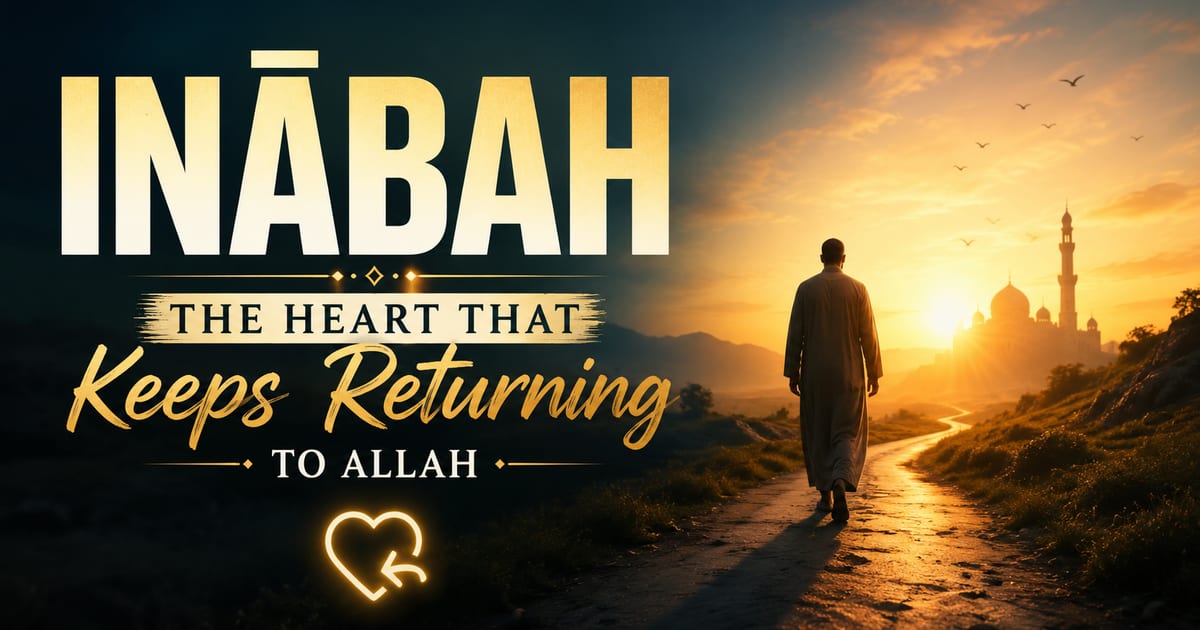
🌿 INĀBAH — The Heart That Keeps Returning to Allah
You may fall.
You may become distracted.
You may make mistakes.
But the righteous heart knows where to return.
🌙 What Does “Inābah” Mean?
The Arabic word Inābah (الإنابة) means:
To turn back and return to Allah again and again.
A person who practices Inābah is called a:
مُنِيب — Munīb
A munīb is someone whose heart continually returns to Allah.
In simple words:
Inābah means: “Whatever happens to me, I return to Allah.”
When I sin → I return to Allah.
When I am worried → I return to Allah.
When I receive a blessing → I return to Allah with gratitude.
When I have an important decision → I seek Allah's guidance.
When my heart becomes attached to the dunya → I bring it back to Allah.
When I fall again → I do not give up. I return again.
That is Inābah.
📖 Allah Commands Us to Have Inābah
Allah says:
وَأَنِيبُوا إِلَىٰ رَبِّكُمْ وَأَسْلِمُوا لَهُ
“Turn to your Lord in repentance, and fully submit to Him…”
📖 Surah Az-Zumar 39:54
Allah does not merely tell us to recognize our mistakes. He tells us to turn back to Him and submit ourselves to Him.
So true Inābah affects our actions as well as our heart.
❤️ The “Returning Heart”
One of the most beautiful descriptions appears in Surah Qāf.
Allah says:
مَنْ خَشِيَ الرَّحْمَٰنَ بِالْغَيْبِ وَجَاءَ بِقَلْبٍ مُّنِيبٍ
“Who feared the Most Merciful unseen and came with a heart returning [to Him].”
📖 Surah Qāf 50:33
Notice the expression:
قَلْبٍ مُّنِيبٍ
Qalbin Munīb
A heart that keeps returning to Allah.
This teaches us something important.
Islam is not only about what our bodies are doing.
Allah wants our hearts to return to Him.
A person may be busy with business, family, responsibilities and difficulties—but deep inside, his heart knows:
“My Lord is Allah. My help comes from Allah. My forgiveness comes from Allah. My destination is Allah.”
That is a qalbun munīb.
🧭 Inābah Is Connected to Guidance
Allah says:
وَيَهْدِي إِلَيْهِ مَنْ أَنَابَ
“…and He guides to Himself whoever turns to Him.”
📖 Surah Ar-Ra‘d 13:27
This is extremely powerful.
Sometimes we ask:
“How can I receive more guidance?”
One answer from the Qur’an is:
Turn toward Allah.
Guidance is not merely information.
A person may know many things but still be far from Allah.
The person of Inābah sincerely says:
“Ya Allah, show me what is right. Help me accept what is right. Help me leave what displeases You.”
And Allah tells us that He guides those who turn toward Him.
🌿 Prophet Ibrāhīm عليه السلام Was a Man of Inābah
Allah describes Ibrāhīm عليه السلام:
إِنَّ إِبْرَاهِيمَ لَحَلِيمٌ أَوَّاهٌ مُّنِيبٌ
“Indeed, Abraham was forbearing, tender-hearted, and ever turning to his Lord.”
📖 Surah Hūd 11:75
Among his beautiful characteristics was:
مُّنِيبٌ — Munīb
He was continually returning to Allah.
This teaches us that Inābah is not only something for a sinner immediately after committing a sin.
It is a way of living.
The believer repeatedly turns toward Allah throughout life.
🌧️ What Is the Difference Between Tawbah and Inābah?
They are closely connected and sometimes overlap.
But an easy way to understand them is:
Tawbah:
“I committed something wrong, so I repent and return to Allah.”
Inābah:
“My entire heart and life keep turning toward Allah.”
Therefore, Inābah includes repentance, but its meaning can be broader.
It includes:
❤️ Loving Allah
🤲 Seeking Allah
😔 Repenting to Allah
🕌 Obeying Allah
📖 Following His revelation
🌧️ Asking His forgiveness
🧭 Seeking His guidance
🤍 Trusting Him
🙏 Remembering Him
🌿 Returning to Him whenever the heart wanders
💔 Inābah Does Not Mean You Never Fall
This is important.
A person of Inābah is not necessarily someone who never makes a mistake.
Human beings make mistakes.
The difference is:
When his heart wanders, he brings it back.
When he sins, he repents.
When he becomes proud, he humbles himself.
When dunya occupies his heart, he remembers the Ākhirah.
When difficulty arrives, he runs toward Allah rather than away from Him.
And even if he falls repeatedly, he refuses to abandon the road back to Allah.
❤️ Allah Loves the Servant's Return
Rasulullah ﷺ gave us an extraordinary example.
Imagine a man travelling through a dangerous desert.
His camel carries his food and water.
Suddenly, the camel disappears.
He searches until he loses hope.
Without his provisions, he expects death.
Then suddenly he finds his camel
standing before him.
Imagine his joy.
Rasulullah ﷺ taught that:
Allah is even more pleased with the repentance of His servant than that person is upon finding his lost camel.
📚 Sahih Muslim 2747a; see also Sahih al-Bukhari 6309
So when you return to Allah sincerely, do not imagine that Allah does not want you.
Allah loves the repentance of His servants.
🚶 Take One Step Toward Allah
In an authentic hadith, Rasulullah ﷺ narrated that
Allah says that when His servant draws nearer to Him, Allah draws nearer to the servant; and when the servant comes toward Him walking, Allah comes toward him with even greater nearness.
📚 Sahih Muslim 2675h
The lesson is beautiful:
Do not wait until you become perfect before returning to Allah.
Start returning now.
One sincere sajdah.
One sincere Astaghfirullāh.
One abandoned sin.
One page of Qur’an.
One sincere du‘ā’.
One act of charity.
One repaired relationship.
One decision to obey Allah.
Begin walking toward Allah.
🌅 How Can We Train Ourselves in Inābah?
Make Inābah a daily habit.
1. Start the morning by turning to Allah.
Before becoming occupied with the world, remember Who gave you another day.
2. Keep Istighfār on your tongue.
Say sincerely:
أَسْتَغْفِرُ اللَّهَ وَأَتُوبُ إِلَيْهِ
Astaghfirullāha wa atūbu ilayh.
“I seek Allah's forgiveness and repent to Him.”
3. When you make a mistake, return immediately.
Do not say:
“Later I will change.”
Return now.
4. When facing a decision, ask Allah first.
Train your heart to say:
“Ya Allah, guide me to what pleases You.”
5. Read Qur’an as guidance, not only as information.
Ask yourself:
“What does Allah want me to change after reading this?”
6. When something good happens, return with gratitude.
Say:
Alhamdulillāh.
Recognize that the blessing came from Allah.
7. When hardship comes, return with du‘ā’, ṣabr and tawakkul.
Instead of allowing hardship to push you away from Allah, allow it to bring you closer.
8. Before sleeping, review your day.
Ask yourself:
“Where did my heart go today?”
Then seek forgiveness and return it to Allah.
🤲 A Powerful Daily Practice: Sayyid al-Istighfār
Rasulullah ﷺ taught what he described as the superior form of seeking forgiveness:
اللَّهُمَّ أَنْتَ رَبِّي لَا إِلَهَ إِلَّا أَنْتَ، خَلَقْتَنِي وَأَنَا عَبْدُكَ، وَأَنَا عَلَى عَهْدِكَ وَوَعْدِكَ مَا اسْتَطَعْتُ، أَعُوذُ بِكَ مِنْ شَرِّ مَا صَنَعْتُ، أَبُوءُ لَكَ بِنِعْمَتِكَ عَلَيَّ، وَأَبُوءُ لَكَ بِذَنْبِي، فَاغْفِرْ لِي، فَإِنَّهُ لَا يَغْفِرُ الذُّنُوبَ إِلَّا أَنْتَ
Meaning:
“O Allah, You are my Lord. None has the right to be worshipped except You. You created me and I am Your servant. I remain faithful to Your covenant and promise as much as I am able. I seek refuge in You from the evil of what I have done. I acknowledge Your blessings upon me, and I acknowledge my sin. So forgive me, for no one forgives sins except You.”
📚 Sahih al-Bukhari 6306
This du‘ā’ beautifully trains the heart in Inābah:
You are my Lord.
I am Your servant.
Your blessings surround me.
I admit my mistakes.
I need Your forgiveness.
I return to You.
🌿 A Simple Way to Remember Inābah
Remember these three words:
TURN → RETURN → REMAIN
TURN
Turn your heart toward Allah.
RETURN
Whenever you wander or fall, return to Allah.
REMAIN
Try to remain connected to Allah through Qur’an, ṣalāh, dhikr, du‘ā’, obedience and good deeds.
And when you fail to remain?
Return again.
That itself is part of Inābah.
❤️ Final Reflection
Perhaps righteousness is not about saying:
“I never fall.”
Rather, one of the great qualities of a righteous servant is:
“Whenever I fall, I know where to return.”
Our hearts will experience distractions.
Our īmān may rise and fall.
The dunya will pull us in many directions.
We will make mistakes.
But never allow your heart to forget the road home.
Allah describes the people who come to Him with:
قَلْبٍ مُّنِيبٍ
Qalbin Munīb
“A heart that returns.”
📖 Qur’an 50:33
So make this a principle for your life:
“Whatever happens, I return to Allah.”
Not only after sin.
In happiness—return to Allah.
In sadness—return to Allah.
In success—return to Allah.
In failure—return to Allah.
When confused—return to Allah.
When afraid—return to Allah.
And when you have wandered very far—
return to Allah again.
Because the door of return is one of Allah's greatest mercies.
📚 Authentic References
• Qur’an 39:54 — Command to turn back to Allah and submit to Him.
• Qur’an 50:33 — The qalbun munīb, the returning heart.
• Qur’an 13:27 — Allah guides those who turn to Him.
• Qur’an 11:75 — Ibrāhīm عليه السلام described as munīb.
• Sahih al-Bukhari 6309 / Sahih Muslim 2747a — Allah's joy at His servant's repentance.
• Sahih Muslim 2675h — Drawing near to Allah.
• Sahih al-Bukhari 6306 — Sayyid al-Istighfār.
May Allah make us among those who continually return to Him and allow us to meet Him with a قَلْبٍ مُّنِيبٍ — a heart that always returns to its Lord. Āmīn.