
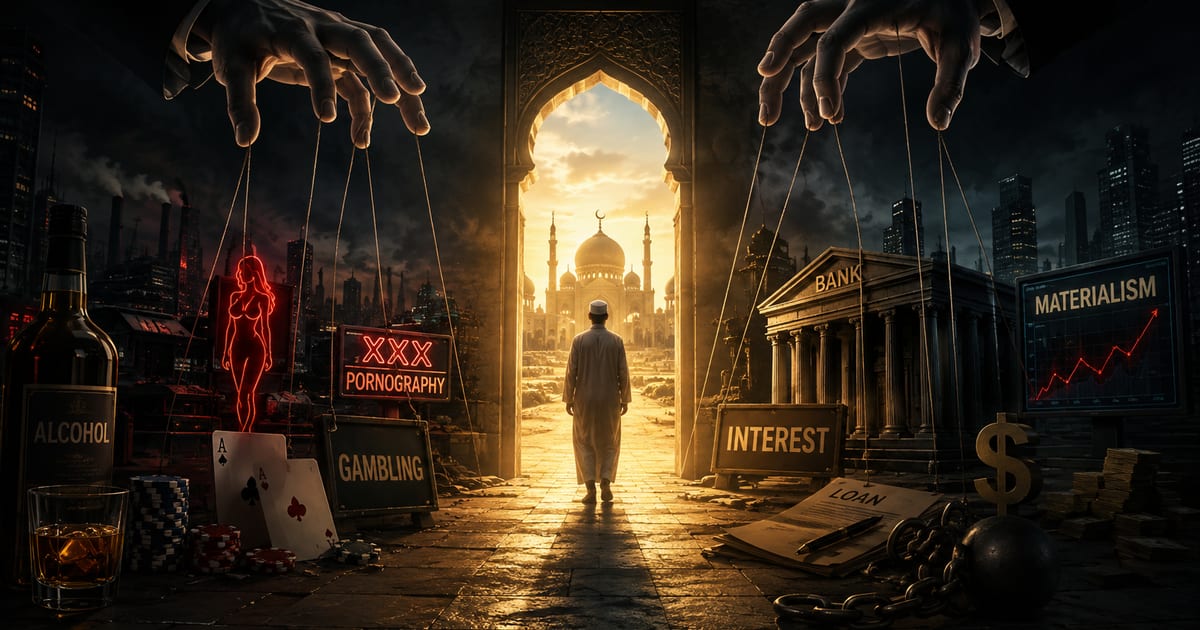
Why Do Powerful Industries Hate Islam? Follow the Money.
Why is Islam so often attacked, mocked, feared, misrepresented or portrayed as a problem?
Why do some powerful institutions, corporations, political systems and industries appear deeply uncomfortable with Islamic teachings?
There are many reasons—political, historical, ideological and cultural.
But there is one question that deserves far more attention:
What happens when Islam says “Haram” to something that generates billions?
Follow the money.
Islam does not merely teach Muslims how to pray.
Islam enters the marketplace.
Islam enters the bank.
Islam enters the casino.
Islam enters the nightclub.
Islam enters the alcohol business.
Islam enters the sexual marketplace.
Islam enters the relationship between employer and employee, lender and borrower, rich and poor, buyer and seller.
And Islam says:
Money does not make wrong become right.
That principle is extremely powerful.
Because whenever an economic system makes enormous profits from something Islam prohibits, Islamic teachings become more than a private religious belief.
They become a challenge to the business model itself.
Islam Says No to Interest
Imagine an economic system heavily dependent upon debt.
A person needs a house.
Debt.
A person needs a car.
Debt.
A business needs capital.
Debt.
A family experiences an emergency.
Debt.
Money is provided—and more money is demanded in return because of the lending arrangement.
Islam enters this relationship and declares:
وَأَحَلَّ اللَّهُ الْبَيْعَ وَحَرَّمَ الرِّبَا
“Allah has permitted trade and forbidden interest.”
— Qur'an 2:275
Islam does not prohibit wealth.
Islam does not prohibit investment.
Islam does not prohibit business.
Islam prohibits ribā.
And the Qur'an's warning is extraordinary:
فَإِن لَّمْ تَفْعَلُوا فَأْذَنُوا بِحَرْبٍ مِّنَ اللَّهِ وَرَسُولِهِ
“…If you do not, then be informed of a war from Allah and His Messenger.”
— Qur'an 2:279
Then look at what Islam teaches concerning someone experiencing genuine financial hardship:
وَإِن كَانَ ذُو عُسْرَةٍ فَنَظِرَةٌ إِلَىٰ مَيْسَرَةٍ
“If someone is in hardship, then let there be postponement until a time of ease.”
— Qur'an 2:280
What a contrast.
One mentality can ask:
“How much can this debt earn?”
Islam asks:
“Is this person suffering? Give him time.”
Islam therefore challenges any financial model that turns another person's vulnerability into unjust gain.
Islam Says No to Gambling
Now walk into another enormous industry.
The casino.
Sports betting.
Online gambling.
Lotteries.
Betting applications.
The message is always attractive:
Maybe you will be the winner.
But for the gambling industry to continue making money, people must continue putting money into the system.
Islam does not tell Muslims to “gamble responsibly.”
Islam attacks the foundation.
Allah says:
إِنَّمَا الْخَمْرُ وَالْمَيْسِرُ... رِجْسٌ مِّنْ عَمَلِ الشَّيْطَانِ فَاجْتَنِبُوهُ
“Intoxicants, gambling… are evil of Satan's handiwork, so shun them so that you may be successful.”
— Qur'an 5:90
Think about the economic consequence if millions of people actually obeyed this command.
They would stop gambling.
Immediately.
For the believer, there is no casino revenue.
No betting revenue.
No lottery revenue.
No gambling addiction to monetise.
The customer walks away.
That is not merely a religious teaching.
For an industry dependent upon that customer's participation, it is an economic threat.
Islam Says No to Alcohol
Now consider alcohol.
Manufacturing.
Distribution.
Advertising.
Bars.
Nightclubs.
Retail.
Entertainment.
An enormous commercial ecosystem can develop around intoxication.
Then Islam tells the believer:
Leave it.
Allah says:
يَا أَيُّهَا الَّذِينَ آمَنُوا إِنَّمَا الْخَمْرُ وَالْمَيْسِرُ... رِجْسٌ مِّنْ عَمَلِ الشَّيْطَانِ فَاجْتَنِبُوهُ
“O you who believe! Intoxicants, gambling… are evil of Satan's handiwork, so shun them.”
— Qur'an 5:90
The Qur'an had already acknowledged something important:
فِيهِمَا إِثْمٌ كَبِيرٌ وَمَنَافِعُ لِلنَّاسِ وَإِثْمُهُمَا أَكْبَرُ مِن نَّفْعِهِمَا
“There is great sin in both, as well as some benefit for people—but the sin is greater than the benefit.”
— Qur'an 2:219
Islam recognises that something harmful can still produce economic benefit.
But Islam says:
Economic benefit does not automatically justify moral and social harm.
Imagine millions of customers saying:
“Allah prohibited it. I don't want it.”
For the believer, the alcohol industry has lost another customer.
Islam Says No to Prostitution and Sexual Exploitation
Sex is also commercially powerful.
Pornography.
Prostitution.
Sexualised entertainment.
Businesses built around turning desire—and sometimes vulnerability—into money.
Islam again stands in the doorway.
Allah says:
وَلَا تَقْرَبُوا الزِّنَىٰ إِنَّهُ كَانَ فَاحِشَةً وَسَاءَ سَبِيلًا
“Do not go near adultery. It is truly a shameful deed and an evil way.”
— Qur'an 17:32
Islam does not merely prohibit the final act.
It establishes boundaries around the roads leading towards it.
It teaches modesty.
It teaches lowering the gaze.
It protects marriage.
It establishes boundaries between men and women.
It rejects prostitution and sexual exploitation.
Why?
Because in Islam:
The human body is not merchandise.
Sexual desire is not a licence for exploitation.
A woman is not a product.
A man is not supposed to become a slave to his desires.
Again, imagine millions of people actually living according to these principles.
Entire streams of commercial demand would shrink.
Now You Begin to Understand the Conflict
This is where the conversation becomes uncomfortable.
Imagine an industry earning enormous amounts from something.
Then a religion tells approximately two billion people:
Don't buy it.
Don't consume it.
Don't participate in it.
Don't advertise it.
Don't sell it.
Don't normalise it.
And most importantly:
Don't allow money to convince you that Allah's prohibition no longer matters.
Would such a religion always be welcomed by industries whose profits depend upon those activities?
That is the question.
Islam Creates a Human Being Who Is Difficult to Exploit
Islam teaches something dangerous to exploitative systems:
Self-control.
The Muslim is taught:
You don't need to drink because everyone else drinks.
You don't need to gamble because everyone else gambles.
You don't need to follow every sexual desire.
You don't need to buy everything advertisements show you.
You don't need to enter every debt offered to you.
You don't need to worship money.
You don't even belong completely to your own desires.
You belong to Allah.
That creates a different type of consumer.
A person who can say:
NO.
No matter how beautiful the advertisement.
No matter how attractive the offer.
No matter how normal society makes it appear.
“Allah has forbidden it. I walk away.”
For industries built around unlimited consumption, that mentality is powerful.
The Vacuum Cleaner Economy
Some systems operate almost like a powerful vacuum cleaner.
First, they invite you in.
Take the loan.
Place the bet.
Try the drink.
Follow the desire.
Buy now.
Pay later.
The entrance is easy.
The advertisement is beautiful.
Then dependency begins.
Debt payments.
Interest.
Another bet trying to recover the previous loss.
Another drink.
Another purchase.
Another subscription.
Another temptation.
And money continues being pulled from the person.
Islam arrives before the vacuum starts and says:
Stop.
Protect your wealth.
Protect your mind.
Protect your body.
Protect your family.
Protect your dignity.
Protect your soul.
Why Would Some Powerful Interests Dislike That?
Because Islam does something extraordinary.
It places morality above the market.
Modern commercial thinking can ask:
“Is there demand?”
Islam asks:
“Is it halal?”
The market asks:
“Can we make money from it?”
Islam asks:
“Is it just?”
The corporation may ask:
“How do we keep the customer consuming?”
Islam asks:
“What is this consumption doing to the human being?”
A government may look at tax revenue.
Islam demands that the moral consequences also be considered.
That is a fundamental clash of priorities.
But We Must Be Fair
This does not mean every bank, company, government, non-Muslim or critic of Islam secretly hates Islam because of money.
That would be an accusation without evidence.
People disagree with Islam for many different reasons.
Muslim-majority countries themselves can also participate in practices contrary to Islamic principles.
Muslims themselves sometimes fail to live according to Islam.
The argument is much more important than a conspiracy theory.
It is this:
Wherever profit depends upon something Islam prohibits, there is an unavoidable conflict between Islamic morality and that economic interest.
You don't need a secret meeting.
You don't need a hidden conspiracy.
The conflict is already built into the incentives.
Islam Is Not Against Business
Islam is strongly connected with commerce.
The Prophet Muhammad ﷺ himself participated in trade.
Islam recognises private property.
Islam permits buying and selling.
Islam encourages contracts, honesty, charity and productive economic activity.
Allah says:
وَأَحَلَّ اللَّهُ الْبَيْعَ
“Allah has permitted trade.”
— Qur'an 2:275
The problem is not money.
The problem is making money without moral limits.
Islam says:
Become successful.
Build businesses.
Create jobs.
Trade.
Invest.
Produce.
Innovate.
Become wealthy if Allah gives you wealth.
But don't destroy people to become rich.
Perhaps This Is Why Islam Makes Some Powerful Systems Uncomfortable
Because Islam cannot be confined to Friday prayer.
You cannot simply tell Islam:
“Stay inside the mosque and don't interfere with the economy.”
Islam follows the Muslim outside.
Into his business.
Into his bank account.
Into his contract.
Into his marriage.
Into his entertainment.
Into his spending.
Into his investment.
Into his workplace.
Into his government.
Into his treatment of the poor.
And everywhere it asks:
What has Allah commanded?
That is why Islam can challenge powerful interests.
Not because Islam opposes prosperity.
But because Islam refuses to worship prosperity.
Not because Islam opposes freedom.
But because Islam asks whether what we call freedom has actually made us slaves to our desires.
Not because Islam opposes business.
But because Islam declares that business itself must answer to morality.
Follow the Money — Then Follow the Damage
When trying to understand why an Islamic prohibition exists, don't only ask:
How much money does this industry generate?
Ask:
How many families were destroyed?
How many people became addicted?
How many people drowned in debt?
How many lost their savings through gambling?
How many people lost control through intoxication?
How many vulnerable human beings were sexually exploited?
And then ask the most uncomfortable question:
Who made money while they were falling?
The Qur'an gives us a principle that cuts through all of it:
وَلَا تَأْكُلُوا أَمْوَالَكُم بَيْنَكُم بِالْبَاطِلِ
“Do not consume one another's wealth unjustly.”
— Qur'an 2:188
Islam came to liberate the human being from slavery to everything except Allah.
From slavery to money.
From slavery to debt.
From slavery to alcohol.
From slavery to gambling.
From slavery to sexual desire.
From slavery to corporations.
From slavery to social pressure.
From slavery even to one's own uncontrolled appetite.
So when someone asks:
“Why Do Powerful Industries Hate Islam?”
Perhaps one place to begin looking is very simple:
Follow the money.
Then look at what Islam prohibits.
Then look at who profits from what Islam tells humanity to leave behind.
And finally, ask yourself: