
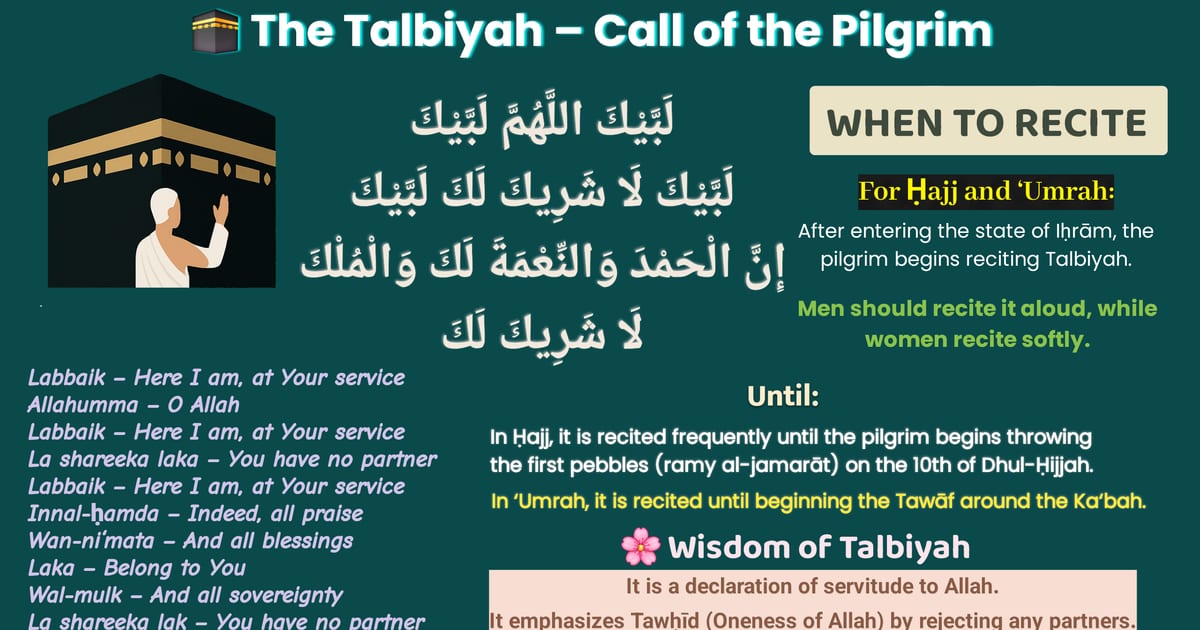
🕋 The Talbiyah – Call of the Pilgrims
﷽
Arabic (التلبية)
لَبَّيْكَ اللَّهُمَّ لَبَّيْكَ
لَبَّيْكَ لَا شَرِيكَ لَكَ لَبَّيْكَ
إِنَّ الْحَمْدَ وَالنِّعْمَةَ لَكَ وَالْمُلْكَ
لَا شَرِيكَ لَكَ
English Translation
“Here I am, O Allah, here I am.
Here I am, You have no partner, here I am.
Verily, all praise, blessings, and sovereignty belong to You.
You have no partner.”
Word-by-Word Translation
Labbaik – Here I am, at Your service
Allahumma – O Allah
Labbaik – Here I am, at Your service
La shareeka laka – You have no partner
Labbaik – Here I am, at Your service
Innal-ḥamda – Indeed, all praise
Wan-ni‘mata – And all blessings
Laka – Belong to You
Wal-mulk – And all sovereignty
La shareeka lak – You have no partner
📌 When to Recite?
For Ḥajj and ‘Umrah:
After entering the state of Iḥrām, the pilgrim begins reciting Talbiyah.
Men should recite it aloud, while women recite softly.
Until:
In Ḥajj, it is recited frequently until the pilgrim begins throwing the first pebbles (ramy al-jamarāt) on the 10th of Dhul-Ḥijjah.
In ‘Umrah, it is recited until beginning the Tawāf around the Ka‘bah.
🌸 Wisdom of Talbiyah
It is a declaration of servitude to Allah.
It emphasizes Tawḥīd (Oneness of Allah) by rejecting any partners.
It reminds the believer that all praise, blessings, and authority belong only to Allah.
👉 Call to Action for Readers:
Whenever we hear the Talbiyah during Ḥajj or ‘Umrah, let it awaken our hearts to renew our submission to Allah and our readiness to serve Him.