
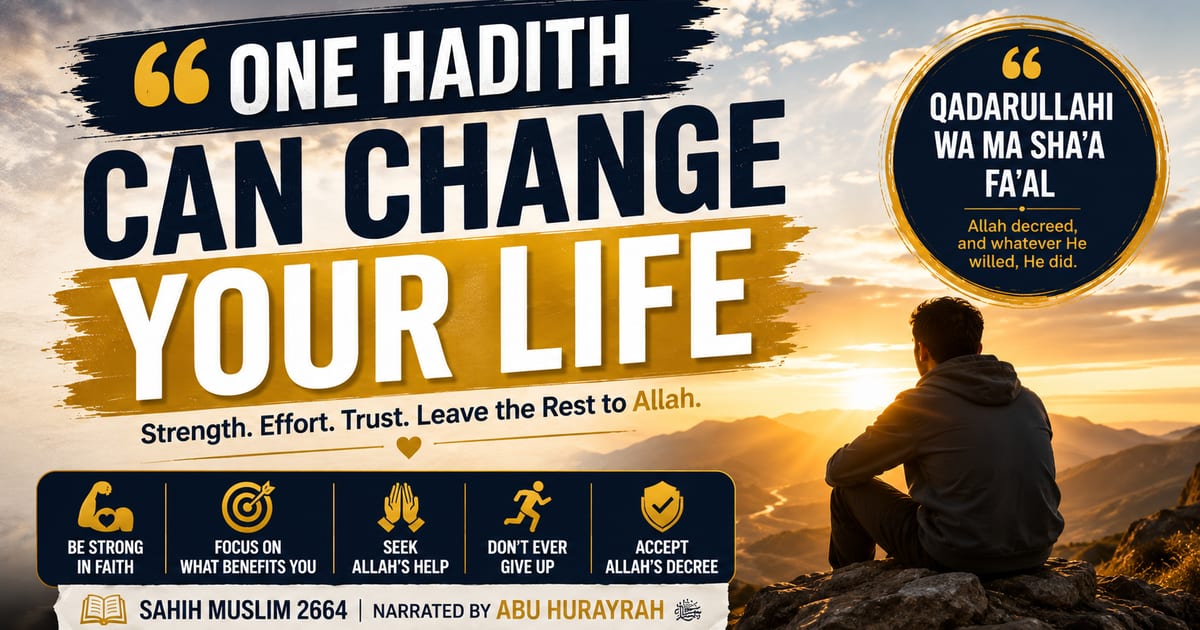
Stop Living in “What If” — A Powerful Hadith About Strength, Effort, Trust and Never Giving Up
There are moments in life when we look backwards and ask:
What if I had made a different decision?
What if I had started earlier?
What if I had taken that opportunity?
What if that business had succeeded?
What if that relationship had worked out?
What if I had taken another road?
Sometimes these thoughts become so heavy that yesterday begins to control today.
But more than 1,400 years ago, Prophet Muhammad ﷺ gave us a remarkable principle for dealing with effort, failure, regret, determination and trust in Allah.
It is a hadith worth remembering throughout our lives.
The Hadith
Abu Hurayrah رضي الله عنه reported that the Messenger of Allah ﷺ said:
Arabic
الْمُؤْمِنُ الْقَوِيُّ خَيْرٌ وَأَحَبُّ إِلَى اللَّهِ مِنَ الْمُؤْمِنِ الضَّعِيفِ، وَفِي كُلٍّ خَيْرٌ. احْرِصْ عَلَى مَا يَنْفَعُكَ، وَاسْتَعِنْ بِاللَّهِ، وَلَا تَعْجِزْ، وَإِنْ أَصَابَكَ شَيْءٌ فَلَا تَقُلْ: لَوْ أَنِّي فَعَلْتُ كَانَ كَذَا وَكَذَا، وَلَكِنْ قُلْ: قَدَرُ اللَّهِ وَمَا شَاءَ فَعَلَ؛ فَإِنَّ لَوْ تَفْتَحُ عَمَلَ الشَّيْطَانِ.
English Meaning
“The strong believer is better and more beloved to Allah than the weak believer, while there is good in both. Be eager for what benefits you, seek help from Allah, and do not become helpless. If something happens to you, do not say, ‘If only I had done such-and-such, then such-and-such would have happened.’ Rather say, ‘Allah decreed, and whatever He willed, He did,’ for ‘if only’ opens the door to the work of Shayṭān.”
Reference: Ṣaḥīḥ Muslim 2664
Narrator: Abu Hurayrah رضي الله عنه
Authenticity: Ṣaḥīḥ
A Complete Philosophy for Facing Life
Look carefully at the order of the Prophet's ﷺ advice.
He does not teach us simply to sit down and say, “Whatever Allah has written will happen.”
Instead, the hadith teaches us a beautiful balance:
Become strong.
Pursue what benefits you.
Ask Allah for help.
Keep going.
Then, after you have genuinely tried, accept Allah's decree.
This is not passivity.
This is effort combined with tawakkul.
1. Become a Strong Believer
The Prophet ﷺ begins:
“The strong believer is better and more beloved to Allah than the weak believer.”
The primary strength being praised is strength in īmān — strength in faith, conviction, obedience and determination upon what pleases Allah.
A strong believer does not mean someone who never struggles.
It means someone whose struggles keep bringing them back to Allah.
When life becomes difficult, strengthen your salah.
When temptation becomes strong, strengthen your self-control.
When uncertainty comes, strengthen your trust in Allah.
When you fall, repent and rise again.
And notice the mercy in the next words:
“And in both there is good.”
The weak believer has not been rejected.
There is good in both because both possess faith.
So this hadith is not telling us to look down upon someone weaker than ourselves.
It is telling us:
Don't remain where you are. Keep growing.
2. Ask Yourself: “Will This Benefit Me?”
Then Rasulullah ﷺ gives an extraordinary principle:
احْرِصْ عَلَى مَا يَنْفَعُكَ
“Be eager for what benefits you.”
Imagine using this principle before making everyday decisions.
Before spending hours scrolling through social media:
Does this benefit me?
Before wasting another night on something meaningless:
Does this benefit me?
Before entering an argument:
Will this benefit my dunya or my akhirah?
Before accepting a business opportunity:
Is it beneficial and halal?
Before choosing friends:
Are these people helping me become better?
Before spending our limited time:
Is this taking me somewhere worthwhile?
Our time on this earth is limited.
Hours become days.
Days become years.
And years become a lifetime surprisingly quickly.
Islam does not teach us to waste that lifetime.
Pursue beneficial knowledge.
Build beneficial businesses.
Develop useful skills.
Take care of your family.
Protect your health.
Serve people.
Increase your worship.
Prepare for your akhirah.
Build a life that benefits you and benefits others.
3. But Don't Depend Only on Yourself
Immediately after telling us to pursue what benefits us, Rasulullah ﷺ says:
وَاسْتَعِنْ بِاللَّهِ
“And seek help from Allah.”
This changes everything.
Islam does not teach:
“Believe in yourself and you can accomplish anything.”
The believer understands something deeper:
I will make every reasonable effort — but my success ultimately comes from Allah.
You can have intelligence.
Money.
Connections.
Experience.
A perfect business plan.
Excellent doctors.
Good opportunities.
But without Allah's permission, none of them independently guarantees the outcome.
So work hard — but make duʿā.
Plan — but make istikhārah when appropriate.
Study — but ask Allah for beneficial knowledge.
Seek treatment — but remember that healing ultimately comes from Allah.
Build your business — but ask Allah for halal rizq and barakah.
Raise your children — but continuously ask Allah to guide them.
Take the means available to you while keeping your heart attached to the One who controls the results.
4. Three Words for Anyone Thinking of Giving Up
Then comes an incredibly powerful instruction:
وَلَا تَعْجِزْ
“And do not become helpless.”
Do not surrender yourself to incapacity.
Perhaps you tried something and failed.
Try again with greater wisdom.
Perhaps your business collapsed.
Learn, adjust and continue through a halal path.
Perhaps you made mistakes.
Repent, learn and move forward.
Perhaps your plans did not happen according to your timetable.
That does not mean Allah has abandoned you.
A believer can become tired.
A believer can feel disappointed.
A believer can even cry.
But disappointment does not have to become surrender.
As long as Allah gives you another morning, there may still be another opportunity to do good.
Do what benefits you.
Ask Allah for help.
And keep moving.
5. Then Comes Qadar
Suppose you did everything reasonably possible.
You planned.
You worked.
You made duʿā.
You sought advice.
You took the necessary means.
And still...
It didn't happen.
The job went to someone else.
The business failed.
The marriage proposal didn't proceed.
The flight was missed.
The opportunity disappeared.
Something happened that you desperately wished had happened differently.
Now the hadith teaches another kind of strength.
The strength to accept what has already occurred.
The Prophet ﷺ taught us not to torture ourselves with counterfactual regret:
“If only I had done this...”
“If only I hadn't gone there...”
“If only I had started earlier...”
Instead, say:
قَدَرُ اللَّهِ وَمَا شَاءَ فَعَلَ
Qadarullāhi wa mā shā'a faʿal.
“Allah decreed, and whatever He willed, He did.”
This sentence does not mean we refuse to learn from mistakes.
A Muslim should reflect, learn, correct mistakes and make better decisions next time.
The warning concerns the kind of “if only” that becomes an objection to what has already occurred, trapping the heart in regret and opening the door to Shayṭān.
Learn from yesterday.
But don't live inside yesterday.
6. Your Responsibility Is the Effort — The Result Belongs to Allah
There is tremendous peace in understanding this.
Before something happens:
Plan. Work. Pray. Seek help. Take the means.
After something beyond your control has happened:
Accept Allah's decree and continue forward.
Think about how many things we once desperately wanted but later realised may not have been right for us.
And think about how many painful moments eventually redirected our lives somewhere we never expected.
We do not always know the hidden wisdom behind an event.
Therefore, we should be careful about declaring that every painful event is itself obviously “good” in the way we understand goodness. Rather, the believer knows that Allah is perfectly Wise and that His decree is never outside His knowledge, justice and wisdom.
Sometimes Allah allows us to understand part of that wisdom later.
Sometimes we may never understand it in this dunya.
Faith means trusting Allah even when the complete picture has not yet been shown to us.
7. This Hadith Can Change the Way You Live
Imagine beginning every morning with these principles:
Be strong in faith.
Don't allow every difficulty to pull you away from Allah.
Pursue what benefits you.
Protect your time from things that add nothing to your dunya or akhirah.
Seek Allah's help.
Never become so confident in your abilities that you forget Who gave you those abilities.
Don't surrender to helplessness.
When one halal path closes, look for another.
Accept what has already happened.
Don't allow endless “what ifs” to consume today's opportunities.
That is a powerful way for a believer to live.
If You Are Going Through Something Difficult Today...
Maybe something didn't work out.
Maybe you lost money.
Maybe someone rejected you.
Maybe an opportunity disappeared.
Maybe you made a decision you now regret.
Maybe you are exhausted from trying.
Remember the words of Rasulullah ﷺ:
احْرِصْ عَلَى مَا يَنْفَعُكَ
Pursue what benefits you.
وَاسْتَعِنْ بِاللَّهِ
Seek Allah's help.
وَلَا تَعْجِزْ
Do not surrender to helplessness.
And when you have genuinely done what you can and the outcome is no longer in your hands:
قَدَرُ اللَّهِ وَمَا شَاءَ فَعَلَ
Allah decreed, and whatever He willed, He did.
Your past cannot be rewritten.
But with Allah's permission, your next step can still be different.
So learn.
Make tawbah where necessary.
Correct what can be corrected.
Ask Allah for help.
Then move forward.
Don't spend the life Allah has given you staring endlessly at a door that has already closed.
There may be another door ahead.
And above every plan you make is the decree and perfect knowledge of Allah.
Do your best. Seek Allah's help. Never surrender to helplessness. And trust Allah with what comes next.
May Allah make us believers who are strong in īmān, eager for what benefits us, constantly seeking His help, patient with His decree and steadfast until we meet Him.
Āmīn.
Authentic Hadith Reference
Narrator: Abu Hurayrah رضي الله عنه
Source: Ṣaḥīḥ Muslim
Hadith: 2664
Book: Kitāb al-Qadar (The Book of Divine Decree)
Grading: Ṣaḥīḥ (Authentic)