
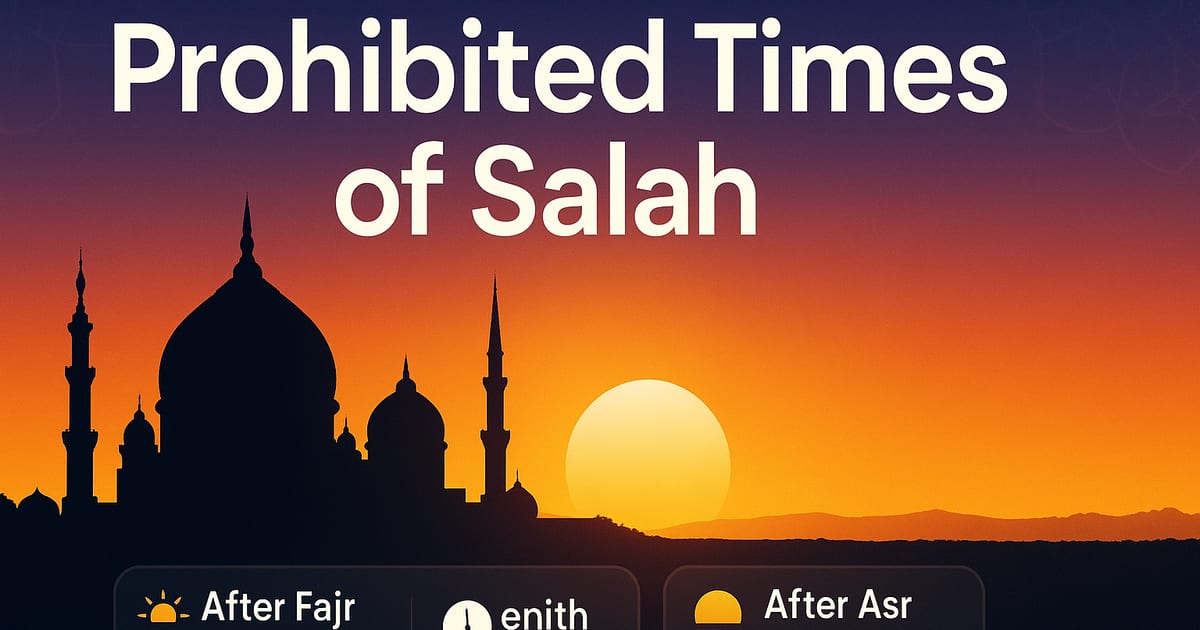
⏳ Prohibited Times of Salah in Islam
Bismillahir Rahmanir Raheem
⏳ Prohibited Times of Salah in Islam
Salah is the most beloved act of worship, but our beloved Prophet Muhammad ﷺ clearly guided us about specific times in the day when voluntary prayers should not be performed. These times are known as Makrūh (prohibited) times of prayer.
📌 Authentic Hadith Evidence
From Abu Sa’id Al-Khudri رضي الله عنه
The Messenger of Allah ﷺ said:
“There is no prayer after the morning prayer until the sun rises, and there is no prayer after the afternoon prayer until the sun sets.”
— Sahih al-Bukhari (586), Sahih Muslim (728)
From ‘Uqbah ibn ‘Amir رضي الله عنه
The Prophet ﷺ forbade us from praying or burying our dead in three times:
When the sun begins to rise until it is fully risen.
When the sun is at its zenith until it passes the meridian.
When the sun draws near to setting until it fully sets.
— Sahih Muslim (831)
✅ Summary of Prohibited Times:
After Fajr until the sun has fully risen (~15–20 minutes after sunrise).
At zenith (Zawāl) — when the sun is at its highest point before Dhuhr.
After ‘Asr until the sun has fully set.
🙏 What Prayers Are Allowed During These Times?
The general rule is no voluntary Salah during these periods. However, scholars clarified some exceptions from Hadith:
Fardh Salah (obligatory prayers)
If a person missed Fajr, Dhuhr, or Asr — they may make up (Qadha) immediately, even in a prohibited time.
Proof: The Prophet ﷺ said: “Whoever sleeps through a prayer or forgets it, let him pray it when he remembers it.” (Sahih al-Bukhari 597, Sahih Muslim 684)
Tahiyyatul Masjid (Greeting the Masjid)
If someone enters the masjid, they may pray 2 rak’ah Tahiyyatul Masjid even in these times.
Proof: The Prophet ﷺ said: “If one of you enters the mosque, let him not sit until he prays two rak‘ahs.” (Sahih al-Bukhari 444, Sahih Muslim 714)
Scholars explain this Hadith is general and not limited by time.
Sunnah of Tawaf
If a person performs Tawaf in Makkah, they may pray the 2 rak’ah Sunnah even in a prohibited time.
Based on reports from Sahabah and rulings of scholars.
🌿 Wisdom Behind Prohibition
These times resemble the moments of sun-worship by non-Muslims in ancient times. Islam prohibits imitation of such practices.
It teaches discipline, prevents excessiveness, and ensures we follow the Sunnah balance between worship and daily duties.
📖 Key Takeaway
Avoid voluntary Salah after Fajr until sunrise, at zenith, and after Asr until sunset.
Exceptions allowed: Qadha prayers, Tahiyyatul Masjid, Sunnah of Tawaf.
✨ Reflection:
The perfection of Salah is not just in performing it — but performing it as Rasulullah ﷺ guided us. These rules remind us that true obedience is in submission.
💬 What do you think?
Have you ever found yourself entering the masjid at one of these prohibited times? What did you do? Share your reflection in the comments!