
Middle East & Geopolitics
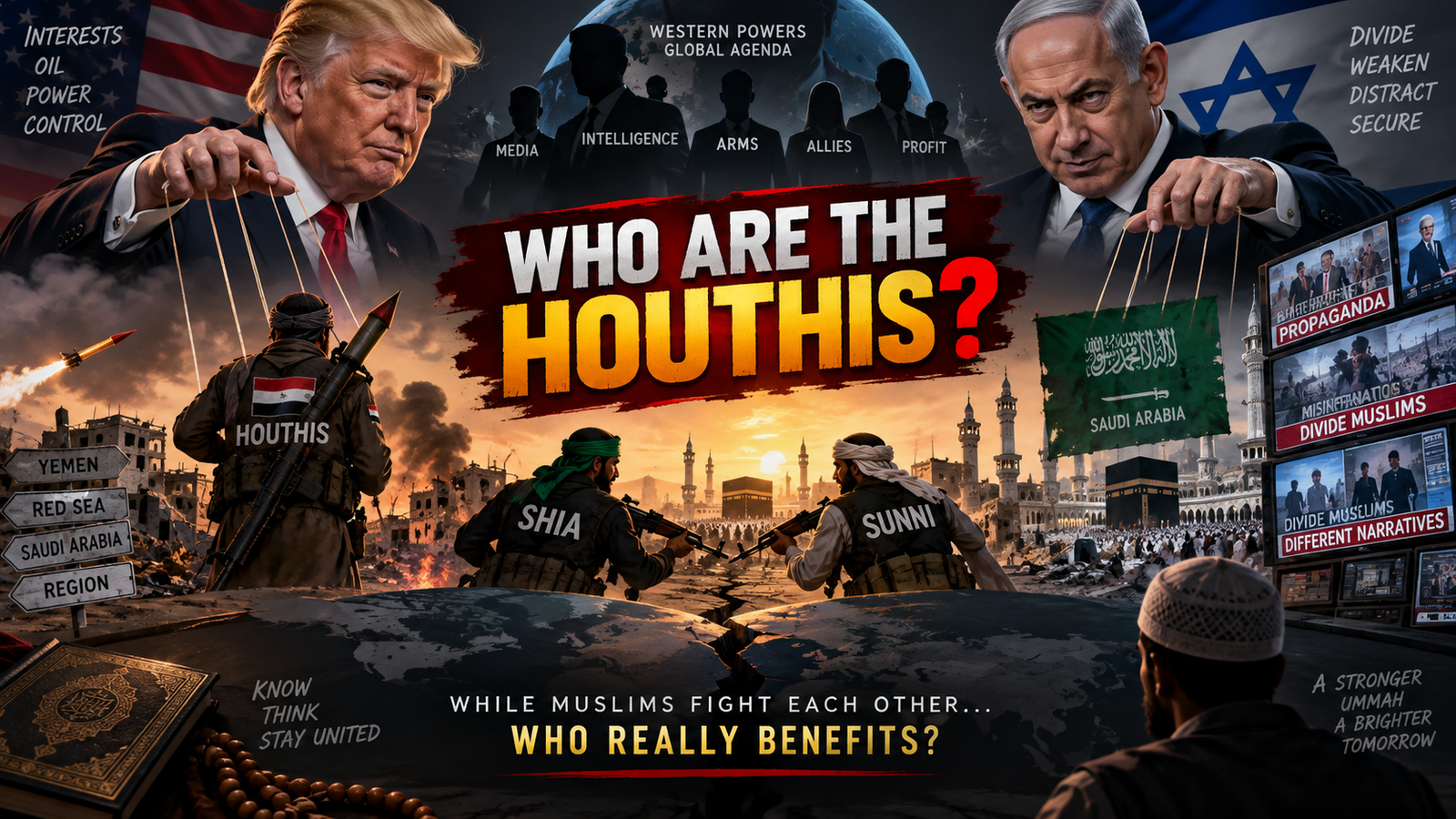
WHO ARE THE HOUTHIS — AND WHO BENEFITS WHEN MUSLIMS FIGHT MUSLIMS?
Who are the Houthis, where did they come from, and who benefits from the growing conflict? Explore their roots, beliefs, Iran connection and the wider geopolitical struggle threatening unity across the Muslim world.
WHO ARE THE HOUTHIS — AND WHO BENEFITS WHEN MUSLIMS FIGHT MUSLIMS?
Understanding Yemen's Ansar Allah, Iran's influence, America's negotiations, Saudi Arabia's confrontation — and why Muslims should be extremely careful before allowing another regional conflict to divide the Ummah.
A New Crisis — But an Old Question
Once again, missiles and drones are flying across the Muslim world.
Saudi cities have come under attack. Yemen is being bombed. Civilians are suffering. Oil infrastructure and international shipping routes are threatened.
And now even the direction of Makkah al-Mukarramah has entered the confrontation.
Before Muslims rush into another battle of slogans, sectarian accusations and social-media propaganda, perhaps we should ask something more fundamental:
Who are the Houthis?
Where did they come from?
Who supports them?
Why is Saudi Arabia fighting them?
Why is Iran supporting them?
Why is the United States simultaneously negotiating with them?
And perhaps most importantly:
Who benefits when Muslims turn their weapons against one another?
1. WHO ARE THE HOUTHIS?
The Houthis call themselves Ansar Allah (Supporters of God).
Their roots are in Sa'dah, northern Yemen, among Yemen's Zaydi Shia population.
The movement developed from a Zaydi religious and political revival during the 1990s and subsequently became associated with Hussein Badreddin al-Houthi.
Conflict with Yemen's government escalated dramatically in 2004.
Hussein al-Houthi was killed that year, and leadership eventually passed to his younger brother:
Abdul-Malik al-Houthi.
Under his leadership, the movement developed from a regional insurgency into one of the Middle East's most powerful armed movements.
In 2014, Houthi forces captured Yemen's capital, Sanaa.
In 2015, Saudi Arabia and its coalition intervened militarily in support of Yemen's internationally recognized government.
The conflict that followed devastated Yemen.
2. ARE THE HOUTHIS SUNNI OR SHIA?
The Houthis originate from Zaydi Shia Islam.
But an important distinction is necessary.
Zaydism is not identical to Iranian Twelver Shiism.
Traditional Yemeni Zaydism differs considerably from the Twelver Shia theology dominant in Iran.
Historically, some aspects of Zaydi jurisprudence and religious practice have been closer to Sunni traditions than those of Twelver Shiism.
Therefore:
Zaydi ≠ Twelver Shia
and equally importantly:
Every Zaydi ≠ Houthi.
It would be unfair and historically inaccurate to blame Yemen's entire Zaydi population for the political and military actions of Ansar Allah.
3. THEN WHERE DOES IRAN ENTER THE STORY?
This is where the modern geopolitical story becomes much more important.
The Houthis originated inside Yemen.
There is no credible evidence that Iran, America, Israel or the CIA originally created the movement.
However, the relationship between Iran and the Houthis subsequently became increasingly important.
Iran has provided the Houthis with forms of military and security assistance, including weapons, technology, training and other support.
This assistance helped transform the Houthis' military capabilities.
Today they possess sophisticated drones and missiles capable of striking targets far beyond Yemen.
Yet even here we should avoid oversimplification.
The Houthis are frequently described as an Iranian "proxy," but some specialists consider "Iran-aligned" or an Iranian "partner" more accurate because the movement retains its own leadership, interests and decision-making.
The distinction matters.
Iranian support is well documented.
Complete Iranian control over every Houthi decision is not.
4. WHY DOES IRAN BENEFIT FROM THE HOUTHIS?
Look at the geography.
Yemen sits beside one of the most strategically important waterways on Earth:
Bab al-Mandeb.
This narrow passage connects the Red Sea with the Gulf of Aden and ultimately the Indian Ocean.
Control or disruption around this region can affect:
🚢 International shipping
🛢️ Oil transportation
🌍 Global trade
🇸🇦 Saudi security
🇪🇬 Access toward the Suez Canal
⚓ Western naval interests
The Houthis therefore give Iran something strategically valuable:
pressure far beyond Iran's own borders.
Iran does not necessarily need Iranian soldiers standing inside Saudi Arabia to create pressure on Riyadh.
An allied armed movement positioned on Saudi Arabia's southern flank can already create enormous strategic consequences.
And recent events have made this relationship even more significant.
5. THE 2026 ESCALATION CHANGES THE PICTURE
Recent reporting indicates that Iranian involvement has become considerably more direct.
Reuters reported in September 2026, citing Yemeni, Iranian and regional sources, that Iran's Revolutionary Guards provided direct guidance during the Houthis' recent offensive along Yemen's Red Sea coast.
The Houthis subsequently intensified attacks against Saudi Arabia.
Saudi territory has been struck with missiles and drones.
Civilian injuries and property damage have been reported.
Saudi oil infrastructure has also come under increasing pressure.
This is no longer simply an internal Yemeni civil conflict.
It has become part of a much larger regional confrontation.
6. AND THEN COMES A VERY INTERESTING DEVELOPMENT: AMERICA IS TALKING TO THE HOUTHIS
This deserves careful attention.
Recent reporting confirms that American officials met Houthi representatives in Oman.
The meeting reportedly concerned maintaining the U.S.–Houthi ceasefire and protecting navigation through Bab al-Mandeb.
U.S. Vice President JD Vance subsequently acknowledged continuing communication.
President Donald Trump also publicly said that the Houthis had contacted his administration seeking U.S. non-intervention in their confrontation with Saudi Arabia.
That fact deserves attention.
But communication does not automatically prove conspiracy or partnership.
Governments routinely negotiate with adversaries during wars.
Nevertheless, Muslims are entitled to ask serious questions about the geopolitical consequences.
7. THE STRANGE TRIANGLE
Consider what is happening simultaneously:
Iran supports the Houthis.
⬇️
Houthis pressure Saudi Arabia.
⬇️
Saudi Arabia seeks outside assistance.
⬇️
United States communicates with both Saudi Arabia and the Houthis.
⬇️
Meanwhile, international shipping, oil prices and regional security are affected.
This does not prove that Washington created or controls the Houthis.
But it illustrates something Muslims should understand:
Major powers deal with different actors according to their strategic interests.
Today's enemy may become tomorrow's negotiating partner.
Today's partner may be denied assistance tomorrow.
International politics is rarely built upon permanent friendship.
It is built largely upon interests.
8. DID AMERICA OR ISRAEL CREATE THE HOUTHIS?
This claim requires evidence.
At present, credible historical evidence does not establish that the CIA, United States or Israel created Ansar Allah.
The movement emerged from Yemen's own political, tribal and Zaydi religious environment.
Similarly, Iran did not originally create the movement.
Iran subsequently developed an increasingly powerful relationship with it.
Therefore, responsible journalism should distinguish between:
❌ "America created the Houthis."
and
✅ "Different regional and global powers may exploit the existence of armed movements and conflicts according to their own strategic interests."
The second proposition can be investigated with evidence.
The first should not be presented as fact without evidence.
9. WHAT ABOUT ISRAEL?
The Houthis publicly present themselves as strongly anti-Israel.
Their official slogan itself contains explicit hostility toward America and Israel.
They have also launched attacks they describe as operations connected with the Palestinian cause.
Therefore, claiming that Israel secretly controls the Houthis would require extraordinary evidence that is presently lacking.
But there is a broader and more important question:
Who strategically benefits when Muslim countries become trapped in internal and sectarian warfare?
That question does not require a conspiracy theory.
Every major state naturally examines conflicts according to its own interests.
America does it.
Iran does it.
Israel does it.
Saudi Arabia does it.
Russia and China do it.
The responsibility of Muslims is therefore not simply to accept the narrative of whichever geopolitical actor they already support.
We should examine evidence.
10. AND NOW — MAKKAH
This is perhaps the most sensitive development.
Saudi Arabia reported in September 2026 that its air defenses intercepted a Houthi drone south of Makkah before it entered the holy city's restricted airspace.
Saudi authorities described Makkah's security and sanctity as a "red line."
The Houthis denied deliberately targeting Makkah or Islamic holy sites.
This distinction must remain in responsible reporting.
Saudi Arabia says Makkah was threatened.
The Houthis deny Makkah was their intended target.
Until independent evidence establishes the intended target, journalism should report both the allegation and the denial.
But every Muslim can agree upon one principle:
🕋 The sanctity of Makkah must never become part of anyone's battlefield.
No political objective, sectarian rivalry or geopolitical alliance should place the Sacred City or innocent people in danger.
11. THIS MUST NOT BECOME "SUNNI VS SHIA"
This may be the greatest danger.
There are profound theological differences between Ahl al-Sunnah wal-Jama'ah and various Shia traditions.
Those differences should be studied seriously through Qur'an, Sunnah and scholarship.
But political conflict must not automatically become hatred against ordinary people.
Not every Zaydi is Houthi.
Not every Shia supports Iran.
Not every Sunni supports Saudi policy.
And governments, armed movements and ordinary Muslims are not interchangeable.
When Muslims stop making these distinctions, political conflicts can become sectarian hatred.
And when that happens, the entire Ummah loses.
12. DON'T ALLOW ALGORITHMS TO THINK FOR YOU
Modern warfare is fought not only with:
🚀 Missiles
🛩️ Drones
🔫 Weapons
It is also fought through:
📱 Social media
📺 Television
🎥 Viral videos
📰 Selective headlines
🤖 Algorithms
🧠 Psychological influence
One side shows you one victim.
Another side shows you another.
One government calls an operation "self-defense."
Its opponent calls the same event "aggression."
Our responsibility is therefore simple:
Verify before believing.
Separate evidence from allegation.
Separate theology from geopolitics.
Separate governments from ordinary people.
And never allow anger to replace justice.
Allah commands:
"O you who believe! If an evildoer brings you any news, verify it..."
Qur'an 49:6
That principle may be more important today than ever.
13. FOUR QUESTIONS FOR THE BELIEVER
When the world appears chaotic, the believer should remember something deeper than geopolitics.
Ask yourself:
1️⃣ Does Allah know what is happening?
Yes.
Nothing occurring in Yemen, Saudi Arabia, Iran, Palestine, America or anywhere else escapes His knowledge.
2️⃣ Is Allah Al-Hakim — the Most Wise?
Yes.
Our knowledge is limited.
His wisdom is complete.
3️⃣ Is Allah Al-'Adl — perfectly just?
Yes.
No injustice ultimately escapes His judgment.
4️⃣ To whom does everything ultimately belong?
To Allah.
"Indeed, to Allah belongs whatever is in the heavens and whatever is on the earth."
Qur'an 4:126
Governments rise.
Empires fall.
Leaders disappear.
Borders change.
But Allah remains.
CONCLUSION: MUSLIMS NEED KNOWLEDGE, NOT ANOTHER SECTARIAN WAR
The lesson from Yemen should not simply be:
"Choose a side."
The lesson should be:
Understand before judging.
Know who the Houthis are.
Understand their religious and political history.
Understand Iran's relationship with them.
Understand Saudi Arabia's security concerns.
Understand America's strategic calculations.
Understand the importance of Bab al-Mandeb.
And understand how easily political warfare can be transformed into sectarian hatred.
Most importantly, Muslims should refuse to surrender their judgment to governments, influencers, television channels or algorithms.
We can disagree.
We can identify theological error.
We can condemn injustice.
We can oppose attacks on civilians.
We can defend the sanctity of Makkah and Madinah.
But we must still remain truthful.
Evidence before accusation.
Justice before tribalism.
Knowledge before emotion.
And Allah knows best.
EDITORIAL NOTE
This article distinguishes between independently reported events, claims made by parties to the conflict, and analysis. Allegations concerning responsibility or intention should not be treated as established facts unless supported by credible evidence.
Asni News | Analysis & Perspective
- #Houthis
- #Ansar Allah
- #Yemen
- #Saudi Arabia
- #Iran
- #Middle East
- #Zaydi Shia
- #Sunni Shia
- #Makkah
- #Red Sea
- #Bab al-Mandeb
- #United States
- #Israel
- #Geopolitics
- #Muslim World
- #Regional Conflict
- #Iran Houthis
- #Saudi Houthi Conflict
- #Islamic World
- #News Analysis