
Sunnah & Dua
Sacred Threads: Authentic Duas for Dressing and Wearing New Clothes in Islam
Discover the authentic Sunnah duas taught by Prophet Muhammad (peace be upon him) for putting on daily clothes and new garments, complete with Arabic text and meanings.
In our daily lives, simple acts often turn into subconscious habits. From grabbing a shirt in the morning to preparing for a formal event, dressing is something we do without much thought. Yet, in Islam, the ordinary is elevated into the sacred. By reviving the beautiful Sunnah of Prophet Muhammad (peace be upon him), the simple action of dressing can become a continuous source of reward, gratitude, and divine protection.
The Spiritual Beauty of Dressing According to the Sunnah
Clothing in Islam is recognized as both a blessing from Allah (Subhanahu wa Ta'ala) and a means to cover our modesty. Allah mentions in the Holy Quran that clothing serves to cover our dignity and as an adornment. Following the Prophetic manner when wearing our garments transforms a physical necessity into an act of worship. The Prophet (peace be upon him) taught us specific invocations (duas) to cultivate mindfulness, express humility, and ward off arrogance whenever we put on our garments.
1. Dua for Putting on Everyday Clothes
Whenever you dress in your daily routine—whether putting on a simple shirt, pants, or a thobe—there is an authentic dua that carries immense forgiveness and gratitude.
Arabic Text:
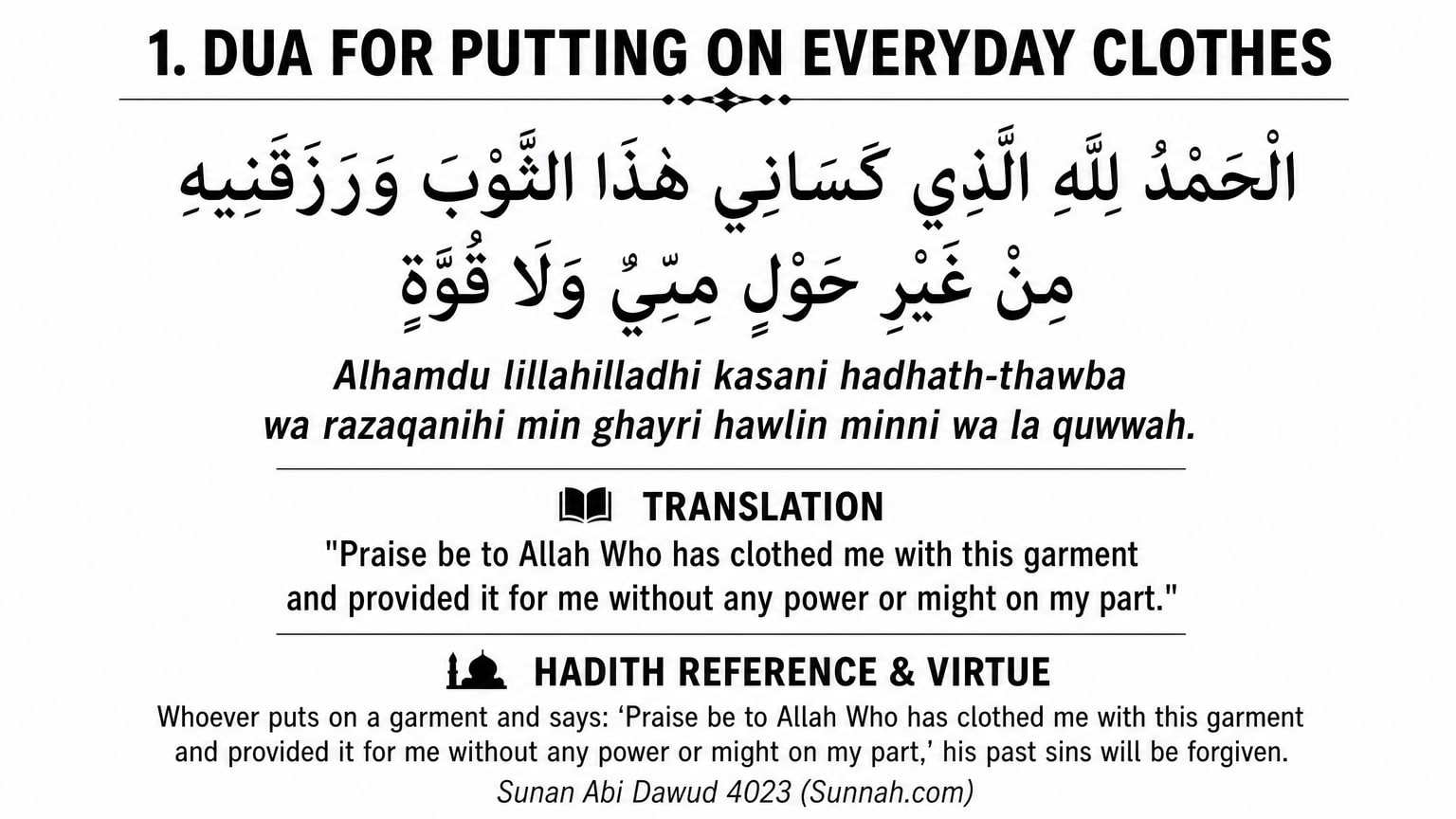
الْحَمْدُ لِلَّهِ الَّذِي كَسَانِي هَٰذَا الثَّوْبَ وَرَزَقَنِيهِ مِنْ غَيْرِ حَوْلٍ مِنِّي وَلَا قُوَّةٍ
Transliteration:
Alhamdu lillahilladhi kasani hadhath-thawba wa razaqanihi min ghayri hawlin minni wa la quwwah.
English Translation:
"Praise be to Allah Who has clothed me with this garment and provided it for me without any power or might on my part."
Hadith Reference & Virtue:
Mu'adh ibn Anas reported that the Messenger of Allah (peace be upon him) said: "Whoever puts on a garment and says: 'Praise be to Allah Who has clothed me with this garment and provided it for me without any power or might on my part,' his past sins will be forgiven."
You can read the complete narration recorded in Sunan Abi Dawud via Sunan Abi Dawud 4023 (Sunnah.com).
Reflecting on the Meaning
This supplication serves as a profound reminder of our complete dependence on the Almighty. We acknowledge that the fabric, the resources to purchase it, and even the physical ability to put it on are pure gifts from our Creator, not solely the result of our own strength or intelligence.
2. Dua for Wearing New Clothes
When putting on a new outfit, an Eid attire, or gifted clothing, the Prophet (peace be upon him) used to mention the specific name of the garment (such as a shirt, turban, or cloak) and make a dedicated prayer seeking its goodness and protection from harm.
Arabic Text:
اللَّهُمَّ لَكَ الْحَمْدُ أَنْتَ كَسَوْتَنِيهِ، أَسْأَلُكَ مِنْ خَيْرِهِ وَخَيْرِ مَا صُنِعَ لَهُ، وَأَعُوذُ بِكَ مِنْ شَرِّهِ وَشَرِّ مَا صُنِعَ لَهُ
Transliteration:
Allahumma lakal-hamdu Anta kasawtanihi, as'aluka min khayrihi wa khayri ma suni'a lahu, wa a'udhu bika min sharrihi wa sharri ma suni'a lahu.
English Translation:
"O Allah, all praise is due to You, You have clothed me with it. I ask You for its good and the good of what it was made for, and I seek refuge in You from its evil and the evil of what it was made for."
Hadith Reference:
Narrated by Abu Sa'eed al-Khudri (may Allah be pleased with him), this narration shows the gratitude of the Prophet (peace be upon him) whenever he was blessed with fresh garments. You can verify this authentic Hadith on Sunan Abi Dawud 4020 (Sunnah.com).
Reflecting on the Meaning
New clothes can sometimes spark vanity, pride, or ostentation in human hearts. By making this supplication, you immediately align your heart back to humility. You ask Allah to let this garment be worn in ways that please Him, while guarding you against vanity, jealousy, and sin.
3. What to Say When You See Someone Else in New Clothes
The Sunnah does not stop at individual practice; it extends warmth and love to fellow believers. When you notice a brother, sister, family member, or friend wearing new attire, the Sunnah encourages offering a supplication for them.
Authentic Prophetic Supplication:
تُبْلِي وَيُخْلِفُ اللَّهُ تَعَالَى
Tubli wa yukhliful-lahu ta'ala — "May you wear it out and may Allah replace it (with another)."
You can reference this tradition documented in Sunan Abi Dawud 4020 and Fortification of the Muslim (Hisn al-Muslim).
Practical Sunnah Etiquettes When Dressing
To maximize the blessings of your daily dressing routine, keep these quick etiquettes in mind:
Start from the right: It was the beloved habit of the Prophet (peace be upon him) to start with the right side when putting on garments and shoes, and to start with the left side when taking them off.
Say Bismillah: Uttering the name of Allah shields your private parts from unseen eyes and brings barakah to your state.
Avoid wastefulness and pride: Choose clothing that is modest, dignified, and free from arrogance.
Bringing the Sunnah into Daily Action
Following the Messenger of Allah (peace be upon him) does not require massive upheavals in your life. It starts with the everyday moments: sliding your arms into your sleeves, buttoning a collar, and acknowledging the blessing on your tongue. Memorize these short invocations, save them on your phone, or write them near your wardrobe, and make every morning a pathway to divine forgiveness.
- #sunnah
- #authentic dua
- #islamic etiquette
- #daily supplications
- #hadith
- #prophetic habits