
Islamic Knowledge
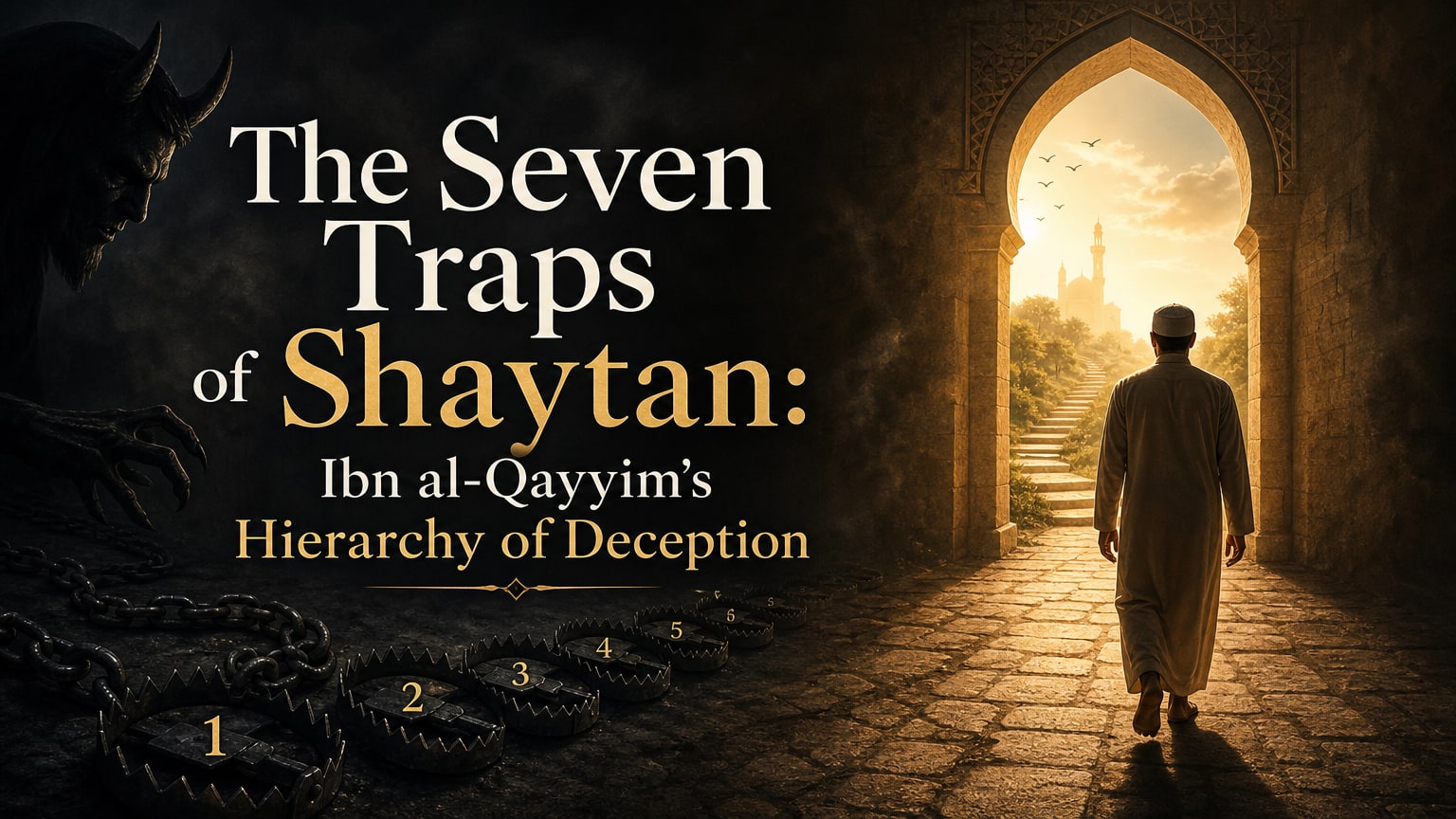
The Seven Traps of Shaytan: Ibn al-Qayyim's Hierarchy of Deception
Discover the seven strategic phases Shaytan uses to lead believers astray according to Ibn al-Qayyim, along with authentic Quranic remedies and shields.
Since the creation of Adam (peace be upon him), Iblis has made it his primary mission to divert humanity from the straight path. Having practiced his deception over millennia, Shaytan does not attack haphazardly. Instead, he follows a calculated, stepwise strategy designed to erode a servant's faith layer by layer. The classical scholar Imam Ibn al-Qayyim al-Jawziyyah outlined this insidious descent in his timeless work Madarij al-Salikin, explaining how the devil advances through seven distinct phases, only dropping down to the next level when he fails at the prior one.
The Open Declaration of Enmity
Allah repeatedly warns mankind of this persistent adversary across the Qur'an. In Surah Fatir, Allah states:
"Indeed, Satan is an enemy to you; so take him as an enemy. He only invites his party to be among the companions of the Blaze." (Surah Fatir, 35:6)
Furthermore, in four separate places in the Qur'an (such as Surah Al-Baqarah 2:168 and Surah Al-An'am 6:142), Allah strictly commands: "Do not follow the footsteps of Satan. Indeed, he is to you a clear enemy." Shaytan openly vowed to ambush humanity on the straight path, approaching from before, behind, right, and left (Surah Al-A'raf, 7:16-17). Understanding his systematic methodology is the first step toward spiritual defense.
The Seven Phases of Shaytan's Trap
1. The Ultimate Ruin: Shirk and Kufr
The primary and supreme objective of Shaytan is to cast a servant into polytheism (shirk) or total disbelief (kufr). Whether through modern intellectual doubts, unchecked philosophy leading to atheism, or visiting graves to seek supplication directly from the deceased rather than Allah alone, Shaytan strives to sever the foundational bond of Tawhid. When a person rejects Allah's oneness or renders halal what Allah has explicitly made haram, Shaytan accomplishes his greatest triumph.
2. Innovation in the Religion (Bid'ah)
If the believer maintains steadfast monotheism and adheres to sound Islamic creed, Shaytan descends to the second trap: religious innovation. Sufyan al-Thawri famously remarked that innovation is dearer to Iblis than common sin, because a sinner knows they are doing wrong and may eventually repent, whereas an innovator believes they are worshipping Allah and consequently does not seek forgiveness. The Prophet Muhammad (peace and blessings be upon him) affirmed:
"He who innovates something in this matter of ours that is not part of it will have it rejected." (Sahih al-Bukhari and Sahih Muslim)
By embellishing newly invented rituals, Shaytan convinces individuals that they are enhancing a deen that Allah already perfected.
3. The Beautification of Major Sins (Kaba'ir)
When the servant remains committed to the Sunnah and avoids innovation, Shaytan turns to major transgressions: adultery (zina), intoxication, consuming usury (riba), and abandonment of obligations. He rarely presents these crimes under their true labels; rather, he renames them enticingly—calling usury "interest," mind-altering substances "lifestyle choices," and illicit relationships "modern courtship." He reminds the servant of Allah's vast mercy while whispering, "Just try it once." Yet experience proves that a single step frequently leads to long-term spiritual devastation and addiction.
4. The Accumulation of Minor Sins (Sagha'ir)
If a person is too conscious of Allah to fall into major sins, Shaytan minimizes small slips—an unlawful glance, backbiting masked as concern, or casual vanity. He whispers that minor sins are automatically erased by regular prayers. However, Anas ibn Malik (may Allah be pleased with him) cautioned the generation after the Companions:
"You do things which you consider smaller than a hair, yet during the lifetime of the Prophet (peace and blessings be upon him), we considered them among the destructive sins." (Sahih al-Bukhari)
Just as a towering mountain is formed by thousands of small pebbles, persistent minor sins accumulate until they harden the spiritual heart. As the scholars noted: "Do not look at how small the sin is, but look at the greatness of the One you disobeyed."
5. Becoming Absorbed in the Excessive Halal (Mubahat)
Should the believer guard their limbs from both major and minor sins, Shaytan attacks through legitimate matters. He encourages excessive indulgence in permissible activities—endless work, overeating, hours of frivolous entertainment, or excessive sleep. While none of these activities are intrinsically sinful, consuming time on non-rewarding pursuits drains spiritual energy, leading to missed prayers, abandoned community service, and neglect of the Quran.
6. Choosing the Lesser Good over the Superior Good
When dealing with a devout worshipper who regulates their time carefully, Shaytan pivots to a subtle tactical trick: nudging them to perform a virtuous deed while abandoning a vastly more rewarding one. For example, he might whisper to someone to sit isolated reading voluntary passages while an essential, highly meritorious communal gathering of knowledge (halaqah) is taking place nearby. By distracting the believer with an inferior good, Shaytan deprives them of the highest stations of divine reward.
7. Direct Harassment and Slander through Human Agents
If a believer withstands all six phases—such as the righteous scholars, revivers, and the Prophets of Allah—Shaytan utilizes his final weapon: mobilizing his human soldiers. He incites wicked individuals to slander the upright, launch smear campaigns, mock their modesty, and plot against their peace. As the servant's faith rises, the intensity of this trial increases, serving as a purification and a testament to their unwavering endurance.
Building the Divine Fortress: Authentic Protections
Despite Shaytan's elaborate blueprint, Allah has equipped the believer with an impregnable defense system. In the Qur'an, Allah provides immediate direction:
"And if there comes to you from Satan an evil suggestion, then seek refuge in Allah. Indeed, He is the Hearing, the Knowing." (Surah Fussilat, 41:36)
The Prophet (peace and blessings be upon him) taught practical daily practices that dismantle Shaytan's influence:
- Ayat al-Kursi: Recited before sleeping, it ensures an angel protects you and Shaytan cannot approach until the morning (Sahih al-Bukhari).
- Al-Mu'awwidhatayn (Surah Al-Falaq and Surah An-Nas): Seeking continuous divine refuge from the whisperer who retreats.
- Consistent Dhikr: The Prophet (peace and blessings be upon him) compared the one who remembers Allah to an individual pursued relentlessly by enemies who takes refuge inside an impenetrable fortress.
- The Morning and Evening Tahlil: Reciting "La ilaha ill-Allah wahdahu la sharika lahu, lahul-mulk wa lahul-hamd, wa huwa 'ala kulli shay'in qadir" provides a day-long protection from the plots of the devil (Sahih al-Bukhari).
By understanding this hierarchy of temptation and anchoring oneself in authentic worship, sincere repentance, and vigilant remembrance, the believer neutralizes the traps of Shaytan and walks firmly upon the path to eternal peace.
- #islamic spirituality
- #ibn al-qayyim
- #shaytan traps
- #quranic reminders
- #hadith
- #tawhid
- #spiritual warfare