
Geopolitics & Defence
Saudi Arabia: One of the World’s Biggest Military Spenders — 74% of Its Major Arms Came From the U.S. So What Should We Ask About Today’s Escalation?
Saudi Arabia is one of the world’s biggest military spenders, while the U.S. supplied 74% of its major arms imports. As tensions rise, we examine the numbers, the defence business and the questions behind them.
Saudi Arabia possesses one of the world's largest military budgets and some of the most sophisticated weapons available. Yet as confrontation with Yemen's Houthis intensifies, another question deserves attention: who supplies this military system, how large is the continuing defence business behind it, and what can the evidence actually tell us about the current escalation?
The purpose of this article is not to declare a hidden agenda as fact. It is to put documented numbers side by side—and allow readers to ask informed questions.
💰 Saudi Arabia: No. 8 military spender in the world
According to the latest Stockholm International Peace Research Institute (SIPRI) estimates, Saudi Arabia spent approximately US$83.2 billion on its military in 2025, an increase of 1.4% from 2024.
That made Saudi Arabia the 8th-largest military spender worldwide. Global military expenditure reached approximately US$2.887 trillion in 2025.
🌍 World's Top Military Spenders — 2025
Rank | Country | Military expenditure |
|---|---|---|
1 | 🇺🇸 United States | US$954B |
2 | 🇨🇳 China | US$336B |
3 | 🇷🇺 Russia | US$190B |
4 | 🇩🇪 Germany | US$114B |
5 | 🇮🇳 India | US$92.1B |
6 | 🇬🇧 United Kingdom | US$89.0B |
7 | 🇺🇦 Ukraine | US$84.1B |
8 | 🇸🇦 Saudi Arabia | US$83.2B |
9 | 🇫🇷 France | US$68.0B |
10 | 🇯🇵 Japan | US$62.2B |
Source: SIPRI, 2025 military-expenditure estimates.
The US$88 billion figure appearing in the WION video should therefore not be mixed with SIPRI's latest figure without qualification. WION states that Saudi Arabia had allocated approximately $88 billion to defence; the latest comparable SIPRI estimate is $83.2 billion.
🇺🇸 Where do Saudi Arabia's major weapons come from?
This is perhaps the more revealing number.
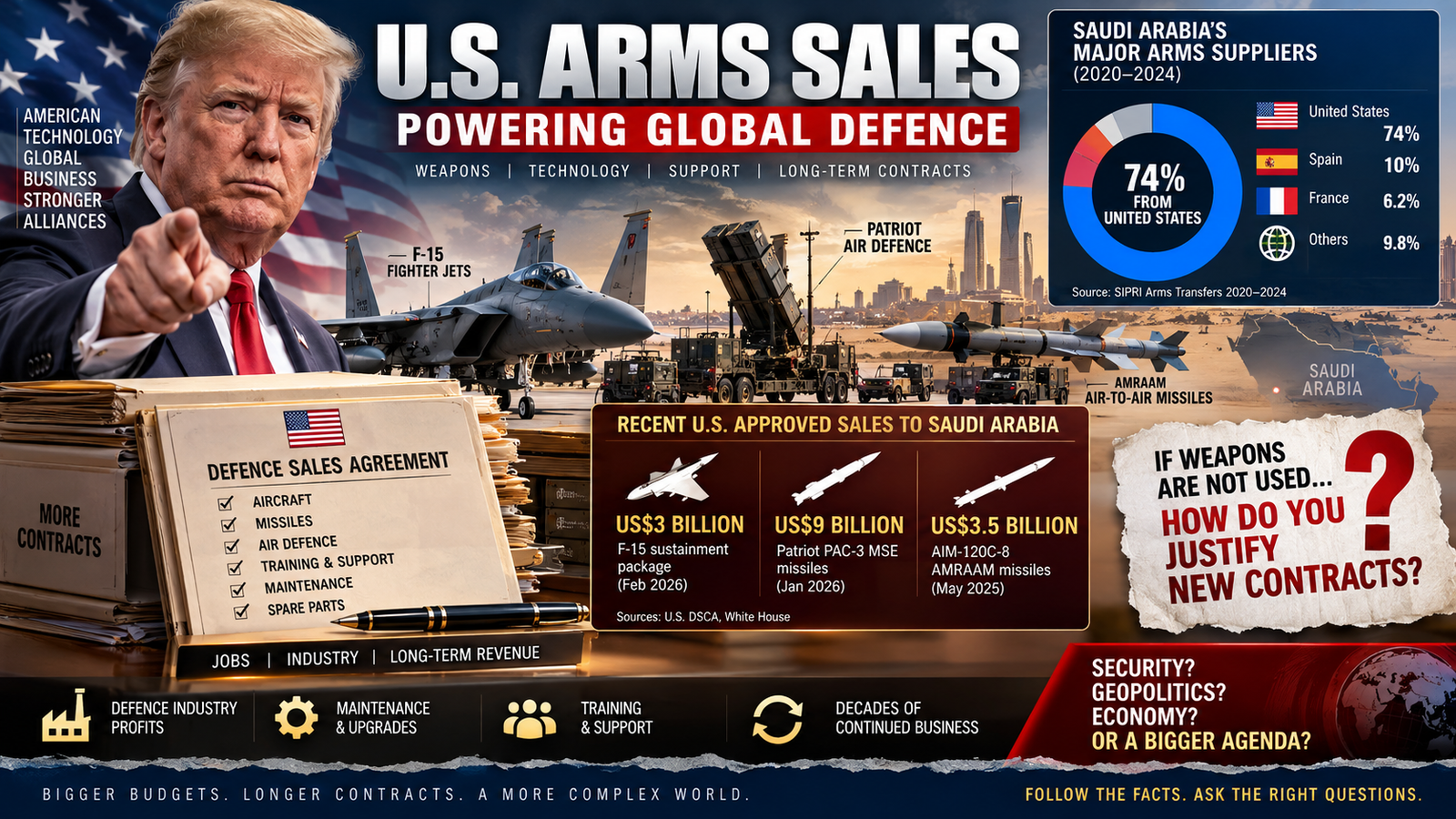
SIPRI found that during 2020–2024, Saudi Arabia was the world's fourth-largest importer of major arms, accounting for approximately 6.8% of global major-arms imports.
Its three largest suppliers were:
Saudi major-arms suppliers, 2020–24
🇺🇸 United States — 74%
🇪🇸 Spain — 10%
🇫🇷 France — 6.2%
🌍 Others — approximately 9.8%
Nearly three out of every four units of Saudi major-arms imports measured by SIPRI during this period came from the United States.
An important technical point: SIPRI's percentages measure the volume of deliveries of major weapons using its Trend-Indicator Value methodology. They are not percentages of Saudi Arabia's total defence budget or dollar spending.
💵 And the defence relationship is continuing
This isn't simply history.
In May 2025, the White House announced what it described as a nearly US$142 billion defence sales agreement with Saudi Arabia involving equipment and services from more than a dozen American defence companies.
The announced areas included air and space capabilities, air and missile defence, maritime and coastal security, border and land-force modernization, communications systems, training and support.
And individual proposed US Foreign Military Sales demonstrate what that relationship can involve.
In May 2025, Washington approved a possible US$3.5 billion sale of 1,000 AIM-120C-8 AMRAAM air-to-air missiles, together with guidance sections and associated support.
Then, on 30 January 2026, the US approved a possible Saudi purchase of 730 PAC-3 MSE Patriot missiles and associated equipment, estimated at US$9 billion.
Only days later, on 3 February 2026, another possible US$3 billion F-15 sustainment package was approved. That package covers parts and repairs, software support, training, engineering, technical assistance and logistics.
There is an important distinction here: these US announcements are approved/proposed Foreign Military Sales or broader agreements, not evidence that every dollar has already been spent or every item delivered.
🔄 Weapons are also a long-term business
This is something easily overlooked when discussing arms sales.
A sophisticated military platform does not generate economic activity only when it is originally purchased.
Aircraft require maintenance. Missiles and interceptors require replenishment. Equipment requires spare parts. Systems require software and upgrades. Personnel require training. Complex platforms require engineering, technical and logistical support.
The 2026 F-15 package illustrates precisely this continuing relationship: its US$3 billion estimated value concerns sustaining aircraft Saudi Arabia already operates rather than simply purchasing a completely new fleet.
That means the defence relationship between supplier and customer can continue for decades.
But an important distinction must also be made:
The existence of a commercial defence industry does not by itself prove that a supplier creates or prolongs a particular war in order to sell weapons.
Demonstrating such a motive would require separate evidence.
⚠️ Now return to Yemen
This is where today's story becomes particularly sensitive.
According to the WION report, the Saudi-led coalition said it intercepted a Houthi drone allegedly heading toward Mecca. Saudi authorities described the security of the Two Holy Mosques as a red line.
But the Houthis denied that they were targeting Mecca, with a Houthi political official rejecting the allegation.
That difference matters.
Until independent evidence establishes the intended target, responsible reporting should say:
Saudi Arabia says the drone was headed toward Mecca. The Houthis deny targeting Mecca.
It should not transform either side's allegation into an established fact.
💥 And what happened inside Yemen?
According to the same WION segment, a Houthi military spokesman claimed that Saudi Arabia had conducted 52 airstrikes in Yemen during the preceding 24 hours, and accused Riyadh of striking civilian sites including schools and bridges.
Again, this is an attributed Houthi claim in the report, not an independently verified count presented here as fact.
The Saudi-led coalition, meanwhile, said it would take necessary operational measures to protect Saudi sovereignty and respond to attacks.
🧩 So what questions should the public be asking?
Put the documented facts together:
US$83.2 billion — Saudi military expenditure in 2025.
#8 globally — Saudi Arabia's position among military spenders.
74% — US share of Saudi major-arms imports during 2020–24.
Nearly US$142 billion — value of the broader US-Saudi defence sales agreement announced by the White House in 2025.
US$9 billion — estimated value of the possible 730-missile Patriot package approved in January 2026.
US$3 billion — estimated F-15 sustainment package approved days later.
And now a new military escalation is being reported.
These facts justify questions—but they do not answer those questions by themselves.
❓ Questions worth asking
Who benefits economically when regional insecurity drives demand for weapons, interceptors, maintenance and support?
Does dependence on foreign defence technology influence strategic relationships between governments?
How much does every new drone or missile interception cost compared with the weapon being intercepted?
What independently verifiable evidence exists regarding the alleged targeting of Mecca?
What evidence exists regarding the reported strikes inside Yemen and their targets?
And perhaps most importantly:
Are today's military decisions being driven purely by immediate security requirements—or are political, strategic and commercial interests also shaping the wider environment?
Those questions should be investigated rather than answered through assumption.
📰 Follow the evidence—not the propaganda
There is another lesson here.
Propaganda does not necessarily come from only one side of a conflict.
Governments communicate narratives. Armed movements communicate narratives. Militaries release selected information. Political leaders defend their decisions. Defence companies have commercial interests. News organizations choose headlines and framing.
That does not mean every statement is false.
It means claims require evidence.
Saudi Arabia's allegation about a drone headed toward Mecca deserves scrutiny.
The Houthi denial deserves scrutiny.
Claims about 52 Saudi strikes deserve scrutiny.
And suggestions that arms suppliers deliberately encourage conflict for commercial reasons also require evidence before being presented as fact.
The numbers, however, are already significant.
Saudi Arabia is one of the world's biggest military spenders. The United States has been overwhelmingly its largest supplier of imported major weapons. Huge additional US-Saudi defence arrangements have recently been announced. And the military relationship includes not only weapons purchases but years of maintenance, software, training, logistics and replenishment.
The facts deserve attention.
The unanswered questions deserve investigation.
And readers should distinguish carefully between what has been demonstrated, what has been alleged, and what is being inferred.
Sources
SIPRI — Trends in World Military Expenditure 2025
SIPRI — Recent Trends in International Arms Transfers to the Middle East and North Africa
SIPRI — Trends in International Arms Transfers 2024
The White House — U.S.–Saudi Arabia Investment and Defense Agreements, May 2025
U.S. DSCA — Saudi Arabia: Patriot Advanced Capability-3 Missile Segment Enhancement
U.S. DSCA — Saudi Arabia: F-15 Sustainment
U.S. DSCA — Saudi Arabia: AIM-120C-8 Advanced Medium Range Air-to-Air Missiles
- #Saudi Arabia
- #Military Spending
- #Defence Budget
- #United States
- #US Saudi Relations
- #Arms Trade
- #Weapons
- #Defence Industry
- #SIPRI
- #Houthis
- #Yemen
- #Middle East
- #Military Technology
- #F-15
- #Patriot Missile
- #AMRAAM
- #Saudi Military
- #US Arms Sales
- #Regional Security
- #Geopolitics
- #Red Sea
- #Bab el-Mandeb
- #Mecca
- #Defence Contracts
- #Military Analysis