
Comparative Religion
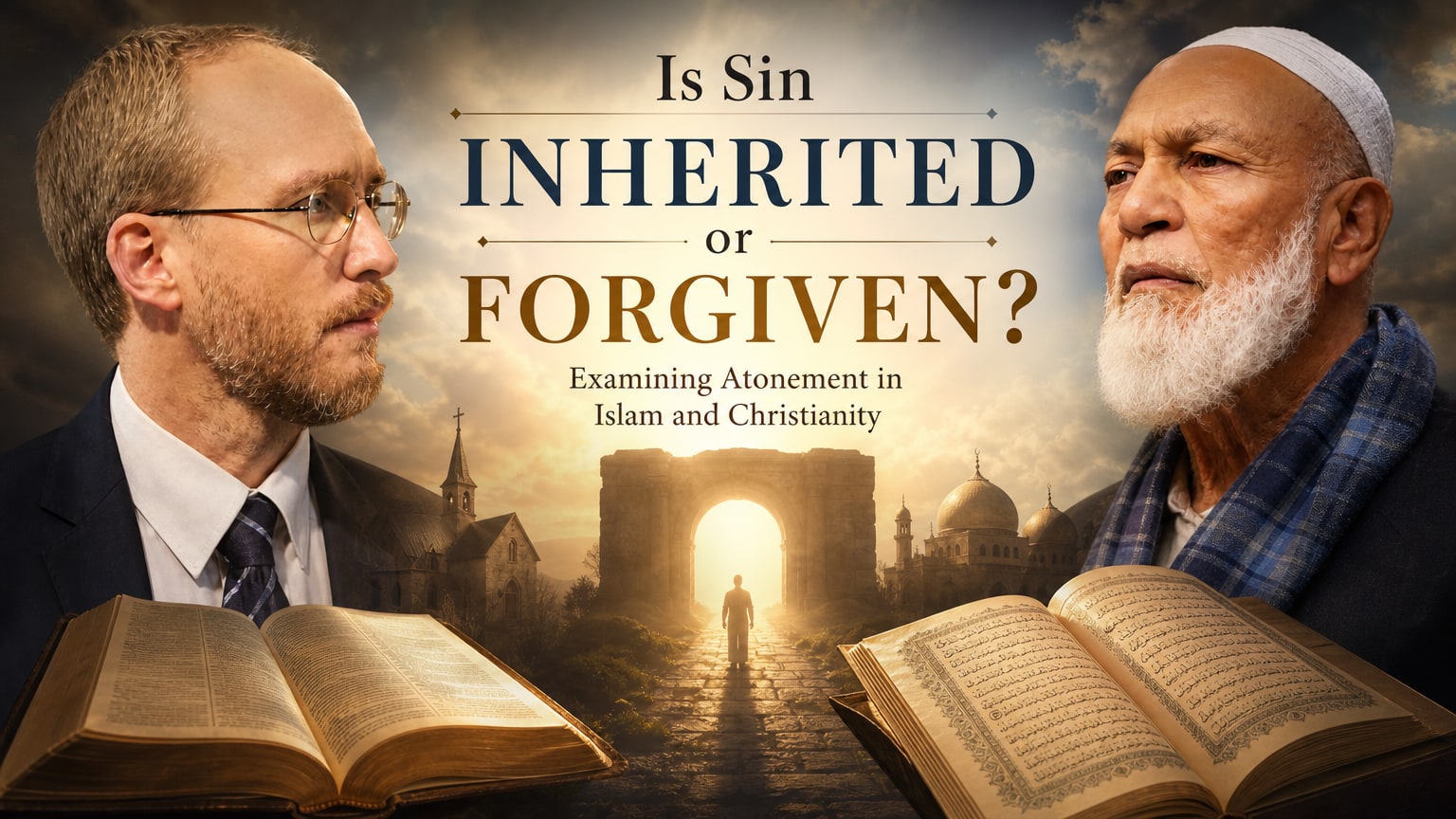
Is Sin Inherited or Forgiven? Examining Atonement in Islam and Christianity
A deep theological breakdown of inherited sin, personal accountability, and divine mercy, examining key scriptural evidence from the Bible and the Holy Qur'an.
Few questions reach into the human heart quite like the mystery of salvation: Are human beings born carrying guilt from ancestral mistakes, or are we held accountable solely for our own choices? In public dialogues between Christians and Muslims, this inquiry frequently takes center stage, revealing profound differences in how both faiths perceive justice, the human condition, and divine mercy.
The Question: Is Sin Inherited or Forgiven Directly?
The central question driving this dialogue is twofold: Does God require a sacrificial substitute to expiate human sin because humanity inherited guilt from Adam, or does God forgive individuals directly based on sincere repentance, personal responsibility, and divine grace? While Christian doctrine historically leans upon the necessity of an atoning sacrifice, Islamic theology presents a radically distinct perspective anchored in personal moral accountability.
Why This Question Matters
This theological divergence shapes how people view everyday moral responsibility, divine fairness, and human potential:
Human Nature: Are babies born sinful and spiritually condemned, or are they born in a state of pure primordial innocence (Fitrah)?
Divine Justice: Can an entirely just Creator punish descendants for crimes committed by their ancestors, or let an innocent party bear the punishment of the guilty?
The Route to God: Is salvation a transaction requiring blood and a mediator, or is it an immediate relationship where turning back to God in sincere repentance brings complete forgiveness?
What Happened in the Discussion
During the referenced public exchange, Christian participants presented their lived convictions. One speaker expressed feeling weighed down by the burden of original sin until finding peace through accepting the atoning sacrifice of Jesus Christ, asserting certainty of salvation. Another participant questioned why Muslims separate Jesus from God if the Qur'an itself designates him as the "Word of God" (Kalimatullah) and a "Spirit from Him" (Ruhun minhu).
In response, Muslim orator Ahmed Deedat countered these assertions by quoting both the Bible and the Qur'an. He emphasized that scripture explicitly rejects inherited guilt, citing the Prophet Ezekiel's declaration that children do not bear the father's iniquity. He further clarified that calling Jesus a "word" from God signifies creation through divine decree—the creative command "Kun" (Be)—rather than co-equality with the Creator.
The Main Arguments Analyzed
The dialogue pivots on two primary structural debates: the mechanism of sin and salvation, and the semantic nature of divine sonship.
1. Original Sin vs. Individual Accountability
Traditional Augustinian Christian theology posits that humanity fell through Adam, inheriting both sinful nature and legal guilt, which only Christ's substitutionary death on the cross can absolve. In contrast, Islam teaches that Adam erred, repented, and was directly forgiven by Allah without needing human sacrifice or ancestral taint passed onto his offspring.
2. The Theological Meaning of 'Word' and 'Spirit'
When the Qur'an mentions Jesus as a "Word from God" and a "Spirit from Him," does this mean he is an uncreated deity? Classical Islamic scholarship explains that Jesus is termed a "Word" because he came into being through God's direct command without a biological father, and a "Spirit from Him" as an honored spirit brought forth by God, precisely as other creations possess spirits willed by Him.
What the Qur’an Says
The Qur'an firmly asserts individual accountability, explicitly negating inherited guilt and human sacrifice for salvation:
وَلَا تَزِرُ وَازِرَةٌ وِزْرَ أُخْرَىٰ ۚ وَإِن تَدْعُ مُثْقَلَةٌ إِلَىٰ حِمْلِهَا لَا يُحْمَلْ مِنْهُ شَيْءٌ وَلَوْ كَانَ ذَا قُرْبَىٰ
Translation: "And no bearer of burdens will bear the burden of another. And if a heavily laden soul calls [another] to [carry some of] its load, nothing of it will be carried, even if he should be a close relative."
— Qur'an, Surah Fatir 35:18
Source: Quran.com - Surah Fatir 35:18
Regarding the annunciation of Isa (Jesus), the Qur'an clarifies the linguistic and theological boundary:
إِذْ قَالَتِ الْمَلَائِكَةُ يَا مَرْيَمُ إِنَّ اللَّهَ يُبَشِّرُكِ بِكَلِمَةٍ مِّنْهُ اسْمُهُ الْمَسِيحُ عِيسَى ابْنُ مَرْيَمَ وَجِيهًا فِي الدُّنْيَا وَالْآخِرَةِ وَمِنَ الْمُقَرَّبِينَ
Translation: "[And mention] when the angels said, 'O Mary, indeed Allah gives you good tidings of a word from Him, whose name will be the Messiah, Jesus, the son of Mary - distinguished in this world and the Hereafter and among those brought near [to Allah].'"
— Qur'an, Surah Ali 'Imran 3:45
Furthermore, the Qur'an strongly repudiates the literal attribution of biological or filial offspring to God:
وَقَالُوا اتَّخَذَ الرَّحْمَـٰنُ وَلَدًا لَّقَدْ جِئْتُمْ شَيْئًا إِدًّا تَكَادُ السَّمَاوَاتُ يَتَفَطَّرْنَ مِنْهُ وَتَنشَقُّ الْأَرْضُ وَتَخِرُّ الْجِبَالُ هَدًّا أَن دَعَوْا لِلرَّحْمَـٰنِ وَلَدًا
Translation: "And they say, 'The Most Merciful has taken [for Himself] a son.' You have done an atrocious thing. The heavens almost rupture therefrom and the earth splits open and the mountains collapse in devastation that they attribute to the Most Merciful a son."
— Qur'an, Surah Maryam 19:88-91
What Authentic Hadith Says
In authentic Sunni tradition, the Prophet Muhammad ﷺ explicitly outlined the innate innocence of every human being at birth, directly contradicting the premise of inherited spiritual corruption:
مَا مِنْ مَوْلُودٍ إِلَّا يُولَدُ عَلَى الفِطْرَةِ، فَأَبَوَاهُ يُهَوِّدَانِهِ أَوْ يُنَصِّرَانِهِ أَوْ يُمَجِّسَانِهِ
Translation: "Every child is born upon the natural disposition (Fitrah), then his parents make him a Jew, a Christian, or a Zoroastrian."
— Sahih al-Bukhari, Hadith 1358 (Sahih)
What the Biblical Texts Say
Examining the Old Testament scriptures reveals verses that vigorously underline individual responsibility over inherited guilt:
"The soul that sinneth, it shall die. The son shall not bear the iniquity of the father, neither shall the father bear the iniquity of the son: the righteousness of the righteous shall be upon him, and the wickedness of the wicked shall be upon him. But if the wicked will turn from all his sins that he hath committed, and keep all my statutes, and do that which is lawful and right, he shall surely live, he shall not die."
— Ezekiel 18:20-21 (KJV)
Source: BibleGateway - Ezekiel 18:20-21
In addition, post-resurrection narratives in the Gospel of Luke depict Jesus affirming his tangible, fleshly physical existence to clear misunderstandings:
"Behold my hands and my feet, that it is I myself: handle me, and see; for a spirit hath not flesh and bones, as ye see me have."
— Luke 24:39 (KJV)
Source: BibleGateway - Luke 24:39
Claim vs. Evidence
Claim: Humanity inherits Adam's guilt and needs a bloody substitutionary atonement to be forgiven.
Evidence: Ezekiel 18:20 explicitly declares that a child will not bear the father's iniquity. Qur'an 35:18 affirms that no bearer of burdens shall carry the load of another.Claim: Being called "Word" and "Spirit" proves Jesus is co-equal deity.
Evidence: In biblical idiom, Adam received God's breath of life (Genesis 2:7) without becoming divine, and multiple righteous figures are metaphorically called "sons of God" (Exodus 4:22, Jeremiah 31:9). In Islamic theology (Tafsir Ibn Kathir on Qur'an 3:45), "Word" denotes the decree "Kun" (Be), not divine essence.Claim: The sacrifice of Abraham's son was meant to establish human substitutionary atonement.
Evidence: Genesis 22:12 and Qur'an 37:102–107 demonstrate that God forbade human sacrifice, replacing it with an animal to show complete submission while abolishing ancient practices of ritual child sacrifice.
What Can We Learn?
Dialogue between faiths uncovers shared linguistic categories that carry vastly different underlying concepts. Sincere inquiry demands moving beyond assumptions:
Read Contextually: Theological soundbites must be verified against their full scriptural chapters.
Embrace Ethical Dignity: A theology of individual accountability empowers humans to strive for righteousness rather than relying on external vicarious payment.
Engage with Grace: Effective dialogue builds upon mutual respect, objective verification, and peaceful reasoning rather than animosity.
Questions Worth Thinking About
If God can forgive any repentant sinner out of infinite grace, why would an innocent mediator need to be executed?
Does personal responsibility offer a healthier moral foundation for society than inherited ancestral guilt?
Can human beings truly understand God when they apply human familial categories—such as biological fatherhood and sonship—to the Divine?
Conclusion
Ultimately, the discussion between original guilt and personal accountability reveals two diverging worldviews. Islam offers a simple, uncompromising path: every human soul begins clean, stands responsible for its own deeds, and has direct access to the Most Merciful without need of a human sacrifice or priestly intermediary. By consulting primary texts with open hearts and clear logic, seekers can uncover truth through clarity and evidence.
Source Verification and References
The Holy Qur'an:
Surah Fatir (35:18) - Individual accountability: https://quran.com/35/18
Surah Ali 'Imran (3:45) - Jesus as a Word from Allah: https://quran.com/3/45
Surah Maryam (19:88-91) - Rejection of divine offspring: https://quran.com/19/88-91
Surah As-Saffat (37:102-107) - The trial of Ibrahim: https://quran.com/37/102-107
Authentic Hadith:
Sahih al-Bukhari (Hadith 1358) - The Primordial Nature (Fitrah): https://sunnah.com/bukhari:1358
Biblical Scriptures:
Ezekiel 18:20-21 - Individual moral culpability: BibleGateway KJV
Luke 24:36-43 - The physical reality of Jesus: BibleGateway KJV
Genesis 22:1-14 - The testing of Abraham: BibleGateway KJV
Original Debate Source:
Ahmed Deedat Q&A Session: https://youtu.be/vH0Y28eXUBk
Cover Image Prompt (16:9 Realistic Hero Image):
Prompt: A realistic cinematic 16:9 composition featuring an ancient wooden table with two sacred open books—one an ornate Arabic manuscript of the Qur'an and the other an open antique leather-bound Bible. In the warm golden twilight background, a set of balanced brass justice scales sits peacefully beside a silhouette of desert mountain ranges under an expansive sky. Evocative, serene, scholarly, photorealistic lighting, with a quiet atmosphere of contemplation and truth seeking. (Title overlay: "Inherited Guilt or Direct Mercy?" | Subtitle: "Examining Salvation, Atonement, and Scriptural Proof")
- #islam
- #christianity
- #original sin
- #theology
- #quran
- #bible study